
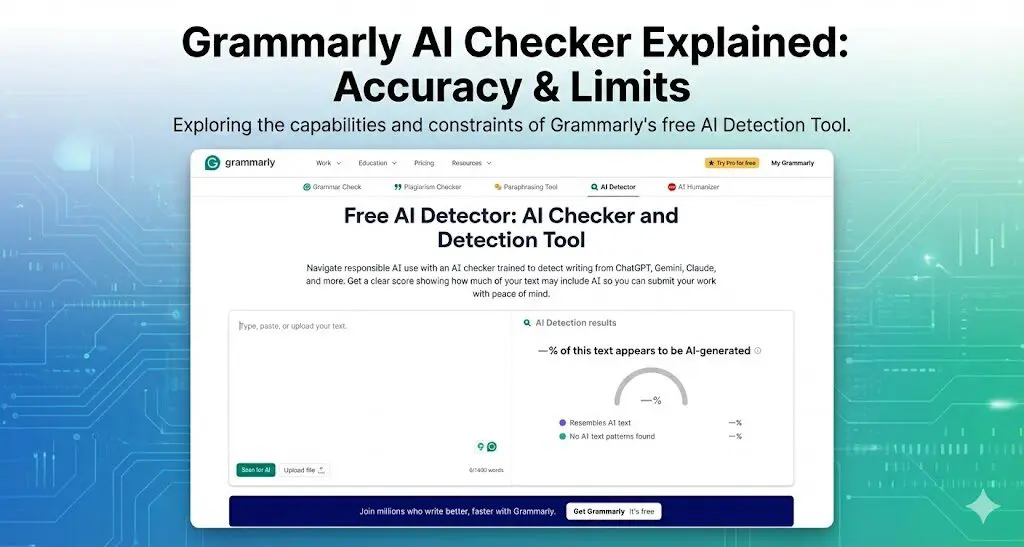
AI-assisted writing is no longer something people experiment with on the side. It is now part of how emails are drafted, essays are revised, reports are structured, and ideas are clarified. Tools like Grammarly sit at the center of that shift, quietly shaping how writing looks long before anyone asks whether AI was involved.
As Grammarly added generative AI features, a new question followed naturally: can Grammarly detect AI writing? And if it can, how reliable is the Grammarly AI checker compared to tools like Turnitin or GPTZero?
That question sounds simple, but it hides a deeper tension.
Most AI detection tools are built around judgment. They scan finished text and attempt to determine whether it crosses a line. Grammarly approaches the problem from the opposite direction. It does not exist to accuse, flag, or enforce. It exists to help people write, revise, and take responsibility for their work.
Understanding the Grammarly AI checker requires understanding that difference. This article explains what Grammarly’s AI detection is actually designed to do, how it works in practice, how accurate it is, and why its limitations are not accidental, but intentional.
What the Grammarly AI Checker Is Designed to Do Text Here
The Grammarly AI checker is not a standalone AI detection tool. It is a feature embedded within Grammarly’s broader writing platform, designed to help users understand whether text shows characteristics commonly associated with AI-generated writing.
Grammarly’s primary product is a writing assistant, not an enforcement system. Its AI detection feature is meant to support transparency and self-awareness, not to accuse or penalize writers.
This distinction matters. Grammarly is built for writers reviewing their own work, not institutions policing submissions. As a result, the Grammarly AI detector is intentionally conservative in how it flags content.
How Grammarly AI Detection Works
At a high level, Grammarly’s AI detection analyzes patterns in writing, not authorship. It looks for signals often found in AI-generated text, such as predictability, structural consistency, and uniform phrasing.
Like other AI writing detection tools, Grammarly does not compare text against a database of AI responses, and it does not identify which model may have produced the content. Instead, it evaluates how closely the writing resembles patterns typically produced by large language models.
Where Grammarly differs is how it uses that signal. Rather than presenting results as definitive judgments, it frames detection as contextual information meant to help writers disclose AI assistance appropriately.
Is Grammarly AI Detection Accurate?
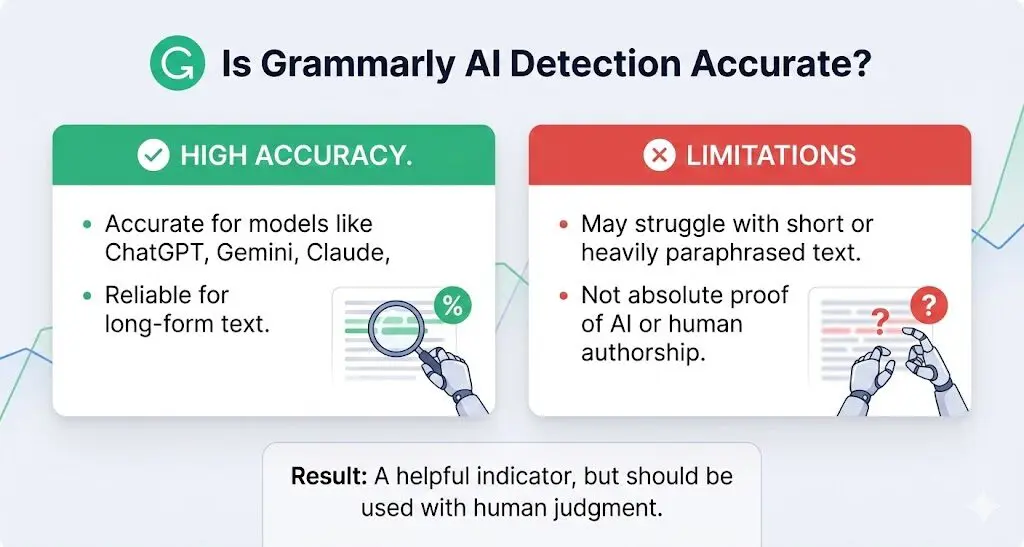
The Grammarly AI checker is moderately accurate in clear cases, but it is not designed to be aggressive.
It performs best when reviewing:
- Raw or lightly edited AI-generated text
- Uniform, highly predictable writing
- Text produced entirely by generative models
Accuracy drops when writing becomes:
- Heavily edited
- Mixed between human and AI
- Stylistically varied or personal
This is expected. Grammarly intentionally avoids labeling borderline cases as AI-generated. Its priority is minimizing false positives that could discourage or penalize legitimate writing.
As a result, Grammarly’s AI detection is best understood as a conservative signal, not a comprehensive filter.
What AI Models Grammarly Can Detect
Grammarly does not attempt to trace text back to a specific AI system. Instead, its detection focuses on identifying writing patterns that are commonly produced by current generative language models.
Based on how the system is described and tested, Grammarly is capable of flagging text that resembles output from:
- ChatGPT and other GPT-based systems
- Google’s Gemini family of language models
- Claude and similar long-form AI writers
- Microsoft Copilot and comparable AI assistants
- Other large-scale transformer models used for paragraph and essay generation
Grammarly’s approach is not tied to any single platform. It evaluates structural and linguistic signals shared across modern AI writing tools, which is why detection confidence decreases as text is revised or blended with human input.
Testing Grammarly AI Checker in Real Writing Scenarios
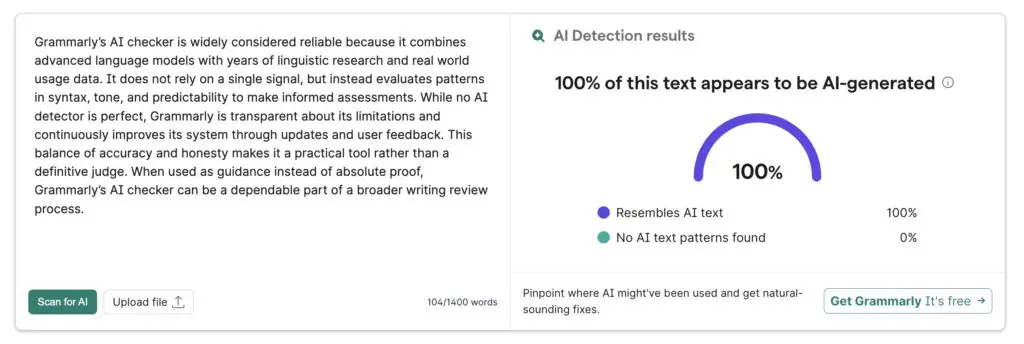
When tested against different types of content, Grammarly’s behavior is consistent with its design philosophy.
Fully human-written text is rarely flagged unless it is extremely structured and uniform. AI-assisted drafts that have been rewritten or refined often pass without strong AI indicators. Raw AI output is more likely to be flagged, especially when it retains a predictable tone and rhythm.
This restraint is intentional. Grammarly’s goal is not to catch every instance of AI use, but to help writers understand when disclosure may be appropriate.
Can You Bypass the Grammarly AI Checker?
Yes. Grammarly’s AI checker can be bypassed. This is not unique to Grammarly. It applies to all current AI writing detection tools.
Grammarly relies on pattern analysis. When writing no longer follows the statistical patterns typical of AI-generated text, detection confidence drops. This happens most often when AI-generated content is heavily edited or blended with human writing.
In practice, Grammarly is less likely to flag text when:
- AI-generated content is heavily rewritten
Reorganizing paragraphs, changing sentence structures, and rewriting ideas in your own words significantly weakens AI detection signals. - Human and AI writing are mixed
Combining AI-generated sections with original human-written content lowers overall detection confidence, especially when the AI portions are not pasted as a single block. - First-person or subjective language is added
Personal opinions, reasoning, reflection, and informal phrasing introduce irregularity that AI-generated text often lacks. - Sentence length and rhythm vary naturally
AI-generated text tends to maintain consistent sentence length and pacing. Mixing short, abrupt sentences with longer, more complex ones reduces predictability. - Dialogue or quoted speech is used
Quoted language, conversational tone, interruptions, and informal exchanges disrupt the smooth structure detection models rely on. - Minor inconsistencies appear
Small punctuation irregularities, sentence fragments, or stylistic imperfections reduce the polished uniformity common in AI output.
Grammarly AI Checker Pricing and Access
Grammarly’s AI checker is included in its paid writing plans and is not offered as a standalone tool.
The free plan ($0) covers basic grammar and spelling checks but does not include full AI detection or plagiarism checking.
AI detection is available with Grammarly Pro (Premium) plans:
- Annual plan: about $12 per month (billed yearly)
- Quarterly plan: about $20 per month
- Monthly plan: about $30 per month
For teams and institutions, Grammarly Business and Grammarly for Education plans offer AI detection with custom pricing based on usage and features.
AI detection can be accessed through the Grammarly Editor, desktop apps for Windows and Mac, and supported browser extensions.
Grammarly AI Checker vs Other AI Detection Tools
Comparing Grammarly to other AI detectors only makes sense if their goals are made explicit.
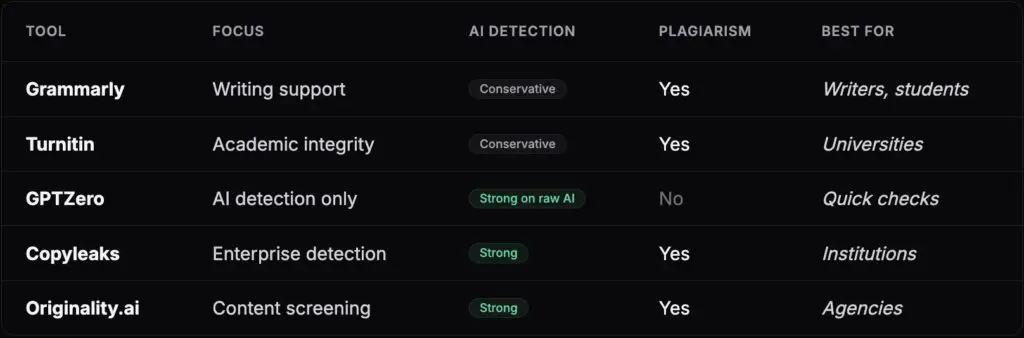
Grammarly vs GPTZero
GPTZero is built to detect AI-generated writing with higher sensitivity. It is commonly used in educational settings where identifying AI use is a priority.
Grammarly is less aggressive by design. It favors user trust and writing support over detection certainty. As a result, GPTZero may flag more content, while Grammarly flags less but with greater caution.
Grammarly vs Turnitin
Turnitin operates within institutional frameworks. Turnitin’s AI detection supports academic review, policy enforcement, and consistency at scale.
Grammarly does none of that. It does not issue reports to instructors or administrators. It does not impose thresholds. It exists entirely on the writer’s side of the process.
These tools solve different problems, and accuracy alone is not a meaningful basis for comparison.
Grammarly vs Dedicated AI Detectors
Tools like Originality.ai and Copyleaks are designed for compliance, publishing workflows, or enterprise review. Grammarly is designed for drafting, revising, and improving writing quality.
Using Grammarly as a primary AI detection tool misunderstands its role. It is a writing assistant that includes detection, not a detector that includes writing help.
How to Think About Grammarly as an AI Detection Tool
Grammarly’s AI checker reflects a broader shift in how writing is evaluated.
As AI assistance becomes normalized, the question is no longer whether AI was used, but whether the writer understands and stands behind the content. Grammarly responds to that shift by emphasizing transparency, process, and disclosure over certainty.
Its AI detection is intentionally limited because certainty in authorship is increasingly unrealistic. Rather than pretending otherwise, Grammarly builds tools that help writers explain how their work was created.
In that sense, Grammarly’s AI checker is not about catching people. It is about helping them take responsibility for their writing in an environment where creation is collaborative by default.
If you need content that reads naturally, reflects genuine understanding, and stands up to both editorial and academic review, Buzzcube provides content writing services built around human-led thinking and careful editorial standards. AI can assist drafting, but quality comes from judgment, structure, and experience. If credibility matters, that’s where the work has to start. Fill out the form.
Frequently Asked Questions
Does Grammarly detect AI writing?
Yes. Grammarly includes an AI checker that analyzes writing patterns commonly associated with AI-generated text and estimates how much content appears AI-written.
How accurate is the Grammarly AI checker?
Grammarly is accurate in clear cases of unedited AI text, but it is conservative by design. Accuracy drops with edited, mixed, or highly structured human writing.
Can Grammarly detect ChatGPT content?
Grammarly can flag text that resembles ChatGPT-style output, especially when it is pasted with little or no human revision.
Can Grammarly’s AI detection be bypassed?
Yes. Like all AI detectors, Grammarly can be bypassed through heavy editing, mixed human-AI writing, sentence restructuring, and stylistic variation.
Is Grammarly better than GPTZero for AI detection?
No. GPTZero is more aggressive and detection-focused. Grammarly prioritizes writing support and transparency over strict AI identification.
Is Grammarly as strict as Turnitin?
No. Turnitin is an institutional tool used in academic review. Grammarly is a writer-facing assistant and does not enforce rules or report results to third parties.
Is Grammarly AI detection free?
No. Full AI detection features are available on paid plans such as Grammarly Pro, Business, and Education. The free plan does not include full AI checking.
What AI models can Grammarly detect?
Grammarly does not identify specific models, but it can flag writing patterns similar to those produced by tools like ChatGPT, Gemini, Claude, and other large language models.
Why does Grammarly sometimes flag human writing?
Human writing that is highly structured, formal, or uniform can resemble AI patterns. Grammarly notes that AI detection results are probabilistic, not definitive.