

Stripe has become the default payment infrastructure for SaaS, subscription products, and product-led businesses. As a result, affiliate programs are no longer simple link tracking exercises. They now depend on accurate handling of trials, recurring billing, refunds, upgrades, and churn.
Many affiliate tools still treat Stripe as a checkout endpoint rather than the billing authority. That gap leads to broken attribution, disputed commissions, and manual reconciliation work that scales poorly.
This guide focuses specifically on affiliate software built for Stripe-based businesses. It evaluates tools based on how they behave in real subscription environments. The goal is to help SaaS teams choose affiliate software that remains reliable as revenue, partners, and complexity increase in 2026.
What Is Stripe Affiliate Tracking Software
Stripe affiliate tracking software is a category of affiliate tools designed to attribute referrals and commissions based on Stripe customer and subscription events rather than standalone checkout actions.
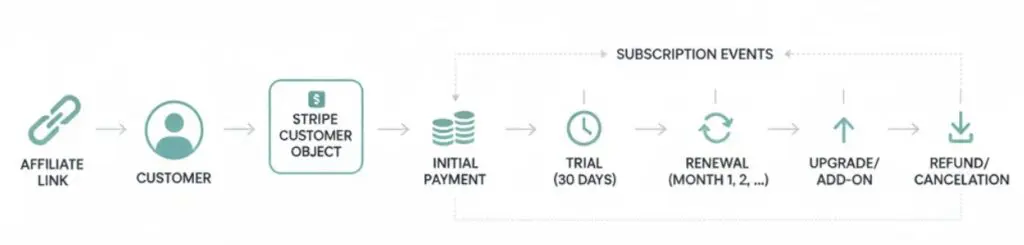
Instead of relying only on browser cookies or referral URLs, these systems track events such as subscription creation, successful payments, upgrades, refunds, and cancellations directly within Stripe. This approach keeps affiliate attribution tied to real revenue activity rather than a single transaction.
The distinction matters for subscription businesses. Revenue is collected over time, not at checkout. Tools that only record the initial payment tend to lose accuracy after the first billing cycle, especially when customers change plans or request refunds.
Stripe-compatible affiliate software either treats Stripe as the billing authority or pulls limited data from it. The depth of that dependency determines how well attribution holds up as subscriptions evolve and is a key factor when evaluating affiliate tools in 2026.
Affiliate Software vs Referral Software vs Partner Platforms
These systems solve different problems, and confusion usually leads to choosing the wrong one too early.
Affiliate Software
Affiliate platforms are built for external promotion that is expected to convert at scale. They work best when pricing, onboarding, and activation paths are already defined. Once traffic increases, attribution accuracy and payout consistency matter more than experimentation.
Referral Software
Referral systems are optimized for customer-driven growth rather than partner management. Rewards are typically credits or discounts, and attribution is simpler. These systems perform well early, when product sharing is informal and growth comes from existing users rather than structured promotion.
Partner Platforms
Partner platforms support longer, more involved revenue paths. Resellers, agencies, and co-selling arrangements introduce delayed conversions and negotiated terms. These systems trade simplicity for control and only become practical when deal size and sales cycles justify the overhead.
How This Plays Out in Practice
Most SaaS products start with referrals, move to affiliates once external promotion becomes intentional, and adopt partner platforms only when revenue per deal increases. Skipping steps usually introduces complexity before it creates leverage.
How These Stripe Affiliate Tools Were Evaluated
The platforms in this guide were assessed based on how they behave once an affiliate program is live, not how they present themselves during onboarding. The focus is on operational reliability rather than feature breadth.
Stripe Dependency
Some tools treat Stripe as the billing authority, while others only pull limited data from checkout events. The difference becomes visible once subscriptions change, refunds occur, or revenue is no longer linear.
Subscription Event Handling
Accurate tracking depends on how well a platform follows the full subscription lifecycle. Trials, upgrades, downgrades, pauses, refunds, and cancellations all introduce edge cases that reveal whether attribution logic is durable or fragile.
Commission Logic
Commission structures tend to evolve. Platforms were evaluated on how well they handle recurring, lifetime, tiered, and capped commissions without requiring frequent manual adjustments.
Operational Overhead
Setup effort is only part of the cost. Ongoing reconciliation, exception handling, and reporting consistency matter more as volume increases. Tools that reduce manual touchpoints hold up better over time.
Affiliate-Facing Experience
Clear dashboards and predictable payouts influence partner behavior. When reporting is easy to understand and aligns with real customer activity, affiliates stay engaged and disputes decrease.
Scaling Constraints
Every system has limits. Evaluation focused on where attribution accuracy, reporting clarity, or payout processes begin to require additional oversight as affiliate activity grows.
Top 5 Affiliate Management Platforms for Stripe in 2026
1. Rewardful
Best Overall for Stripe-First SaaS
Rewardful remains reliable when Stripe Billing is treated as the source of truth. Recurring commissions, refunds, and plan changes stay aligned with Stripe events as subscription volume increases. Most constraints appear around payout operations rather than attribution accuracy.
Handles well
- Recurring and lifetime commissions tied to subscriptions
- Refund and cancellation adjustments without manual intervention
- Clear alignment between Stripe revenue and affiliate reports
Limitations
- Multi-currency payouts become common
- Partner structures require layered approvals
- Finance teams need highly customized payout logic
Best fit
- Subscription-based SaaS with clean billing flows
- Teams scaling affiliates without complex partner hierarchies
2. Tolt
Best Lightweight Option for Early-Stage SaaS
Tolt performs consistently in simple Stripe Checkout setups. Attribution stays accurate for straightforward subscriptions and one-time payments. Constraints surface as commission rules or subscription behavior becomes more complex.

Handles well
- Fast setup with minimal configuration
- Basic affiliate and referral tracking
- Early-stage programs with limited partner volume
Limitations
- Subscriptions change plans frequently
- Commission logic extends beyond simple percentages
- Reporting requirements move beyond surface-level metrics
Best fit
- Bootstrapped SaaS launching an initial affiliate program
- Teams prioritizing speed over long-term flexibility
3. FirstPromoter
Best for Scaling Subscription-Based Affiliate Programs
FirstPromoter maintains attribution accuracy as affiliate programs grow. Trials, upgrades, and recurring charges remain consistent with Stripe data over time. Additional setup is required early, but operational stability improves as volume increases.

Handles well
- Flexible and tiered commission structures
- Subscription upgrades and downgrades
- Larger affiliate bases without reporting drift
Limitations
- Highly customized payout workflows are required
- Multiple non-Stripe revenue sources are introduced
- Teams expect minimal configuration effort
Best fit
- Growing SaaS companies with established affiliate traction
- Programs that need flexibility without enterprise overhead
4. PartnerStack
Best for B2B SaaS and Partner-Led Growth
PartnerStack supports partner-driven revenue rather than simple affiliate promotion. Attribution holds across longer sales cycles, and commission logic supports reseller and agency models. The operational tradeoff only makes sense once deal size increases.

Handles well
- Reseller, agency, and partner relationships
- Longer attribution windows tied to contracts
- Structured partner programs with defined tiers
Limitations
- Products are self-serve with low contract value
- Teams lack dedicated partnership operations
- Cost sensitivity outweighs partner leverage
Best fit
- B2B SaaS with high ACV and partner-led sales
Companies formalizing co-selling motions
5. Impact.com
Best Enterprise-Grade Affiliate Platform
Impact.com provides extensive control and customization. Stripe integration works reliably with careful configuration, but the platform assumes ongoing operational ownership. Complexity becomes the primary tradeoff rather than feature availability.

Handles well
- Large affiliate and partner ecosystems
- Complex commission approval workflows
- Enterprise reporting and compliance needs
Limitations
- Teams are lean or under-resourced
- Programs change frequently without defined processes
- Simplicity and speed are priorities
Best fit
- Enterprises with mature affiliate or partnership teams
Programs where control outweighs setup effort
Affiliate Software Comparison Table
Platform | Stripe Integration Reality | Subscription Accuracy | Recurring Commissions | Primary Risk |
Rewardful | Stripe as system of record | High | Yes | Payout ops |
Tolt | Thin Stripe layer | Medium | Basic | Attribution drift |
FirstPromoter | Deep Stripe integration | High | Flexible | Setup complexity |
PartnerStack | Indirect Stripe usage | High | Advanced | Cost |
Impact | Enterprise integration | High | Advanced | Operational overhead |
Stripe-Compatible Referral Systems vs Full Affiliate Platforms
Referral systems perform well in product-led environments where users naturally invite others. Affiliate platforms are more effective when external partners actively promote content, tools, or education.
Design tools, AI products, and no-code platforms often begin with referral systems and transition to affiliates once external demand increases. Choosing the wrong model early creates unnecessary migration work later.
Best SaaS Affiliate Tools by Business Type
Affiliate software behaves very differently depending on how a SaaS product charges customers. Most problems appear when the software is chosen based on popularity rather than billing reality.
Subscription-First SaaS
Subscription products expose weaknesses in affiliate tracking faster than any other model. Trials, renewals, pauses, and cancellations create revenue events that extend far beyond the initial checkout. Affiliate tools that only listen for the first Stripe charge tend to lose accuracy after the first billing cycle.
Platforms that treat Stripe Billing as the source of truth handle recurring commissions more consistently. Attribution remains intact as long as subscriptions evolve on the same customer object. This approach reduces manual intervention and prevents commission drift over time.
Creator and Design Tools
Products aimed at designers and solo creators rarely begin with structured affiliate programs. Early growth often comes from informal referrals, shared resources, and content-driven promotion. In this stage, heavy affiliate tooling adds friction rather than leverage.
Simple systems perform better because they stay out of the way. As external promotion becomes more deliberate, limitations appear around reporting and commission flexibility. That is usually the signal to move to a full affiliate platform rather than over-engineering from day one.
AI and Usage-Based SaaS
AI products tend to change pricing more often than traditional SaaS. Usage tiers, credit-based billing, and hybrid plans introduce revenue variability that breaks rigid commission models.
Affiliate software in this category must handle upgrades without resetting attribution or miscalculating commissions. Tools that support flexible commission logic adapt better as pricing evolves. Those tied to static plans require frequent adjustments and manual cleanup.
B2B and High-ACV SaaS
In B2B environments, affiliates rarely behave like content publishers. They operate more like partners who influence deals over time. Commission attribution often spans longer cycles and larger contract values.
General affiliate tools struggle here because they assume immediate conversion. Partner-focused platforms perform better by supporting reseller logic, deal tracking, and longer attribution windows. The tradeoff is higher cost and operational overhead, which only makes sense once deal size justifies it.
Affiliate Software for Subscriptions: Common Challenges
Subscription-based affiliate programs fail less often due to traffic and more often due to accounting and attribution gaps.
Churn and Refund Handling
Refunds and cancellations must adjust commissions automatically. Tools that only track the initial transaction require manual corrections after refunds occur. This leads to delayed payouts and recurring disputes, especially once volume increases.
Accurate systems treat refunds as first-class events rather than exceptions.
Plan Changes and Revenue Drift
Upgrades and downgrades create subtle attribution problems. Some tools reset commissions on plan changes, while others ignore revenue differences entirely. Over time, this creates a gap between reported affiliate revenue and actual Stripe data.
Software that follows subscription state rather than payment events reduces this drift.
Reporting Trust Breakdown
Affiliates monitor dashboards closely. Inconsistent reporting erodes trust faster than late payouts. When affiliates cannot reconcile reported earnings with real customer behavior, support requests increase and promotion slows.
Clear visibility into Stripe events reduces ambiguity and keeps expectations aligned.
Payout Operations at Scale
Payout management becomes the first operational bottleneck. Systems that rely on exports, spreadsheets, or manual approvals stop scaling once affiliate volume grows. The issue is rarely technical. It is a process failure caused by tooling that was not designed for scale.
Pricing Models Explained
Affiliate software pricing rarely reflects its true cost in the first few months. The impact appears as programs mature.
Flat Monthly Pricing
Flat pricing favors stability. Costs remain predictable as affiliate revenue grows, which makes forecasting easier. This model becomes more efficient over time, especially when affiliates drive a meaningful share of revenue.
Revenue-Based Pricing
Revenue-based pricing looks attractive early but scales aggressively. As affiliates perform better, software fees increase in parallel. This often becomes noticeable only after affiliates prove successful, at which point switching tools becomes harder.
Stripe-Related Fees
Some platforms add payout processing or transaction-based fees on top of base pricing. These costs often appear after payouts increase and are rarely part of the initial decision process.
Evaluating total cost requires modeling payouts, not just subscription fees.
Operational Overhead
Manual reconciliation, dispute resolution, and reporting adjustments consume time that is rarely accounted for. Over a year, these hidden costs often exceed the software fee itself. Tools that reduce operational touchpoints tend to be cheaper in practice, even if list pricing appears higher.
Future Trends for Stripe Affiliate Programs in 2026
Affiliate tracking is shifting away from browser-dependent attribution toward systems grounded in billing events. Stripe-based attribution reduces data loss and remains stable across devices and sessions.
Privacy changes are accelerating this shift. First-party tracking tied to payment infrastructure avoids reliance on third-party cookies and fragile client-side logic.
Affiliate experience is becoming a competitive factor. Partners increasingly favor programs with clear reporting, predictable payouts, and minimal disputes. Feature depth matters less than reliability.
In 2026, the most effective affiliate programs will be those that prioritize operational clarity over experimentation. Tools that remain boring but accurate tend to outperform those that promise innovation without consistency.
Final Verdict
The best affiliate software for Stripe in 2026 is determined by how deeply it treats Stripe as the billing authority, not by the length of its feature list. Tools that follow subscription state over time maintain accurate attribution as revenue evolves, while checkout-centric systems lose relevance once billing becomes dynamic.
Selecting affiliate software based on how it behaves under real subscription conditions reduces future migrations, limits reconciliation work, and results in affiliate programs that remain reliable as scale and complexity increase.
For teams evaluating broader growth infrastructure beyond affiliate tooling, Buzzcube provides curated insights into SaaS, AI, and design tools that support product-led and partner-driven growth strategies.
Frequently Asked Questions
What is the best affiliate software for Stripe subscriptions in 2026?
The best option depends on how tightly the affiliate software aligns with Stripe Billing. Tools that treat Stripe as the billing authority tend to maintain accurate attribution across renewals, upgrades, refunds, and cancellations. Rewardful and FirstPromoter consistently handle subscription lifecycle events with fewer reconciliation issues than tools focused only on checkout tracking.
Can Stripe track affiliates natively?
Stripe does not provide native affiliate tracking. It records payments and subscription events but does not attribute those events to referring partners. Affiliate software is required to connect referral data with Stripe customer and subscription activity in a reliable way.
What usually causes affiliate tracking issues with Stripe?
Most issues arise after the first payment. Plan changes, refunds, churn, and subscription migrations expose weaknesses in tools that only track checkout events. When attribution is not tied to the ongoing subscription state, reported affiliate revenue gradually diverges from Stripe data.
Are Stripe-compatible referral systems enough for SaaS businesses?
Referral systems work well during early product-led growth when customers invite other customers. As external promotion becomes intentional and revenue attribution matters, referral systems often lack the reporting depth and commission flexibility needed for affiliates. Many SaaS products transition to affiliate platforms once growth channels mature.
How do recurring commissions affect affiliate software choice?
Recurring commissions require the affiliate tool to follow subscription changes over time. Software that calculates commissions per transaction rather than per subscription tends to misreport revenue when customers upgrade, downgrade, or pause plans. Subscription-aware tools maintain consistency as billing evolves.
Is revenue-based pricing a risk for affiliate software?
Revenue-based pricing reduces upfront cost but increases as affiliates perform better. For successful programs, this model can become expensive over time. Flat pricing often provides better cost predictability once affiliates contribute a meaningful share of revenue.
When does it make sense to move from affiliates to partner platforms?
Partner platforms become useful when deal sizes increase and sales cycles lengthen. At that point, affiliates act more like resellers or agencies, and attribution spans longer timelines. For self-serve SaaS with low contract value, the added complexity is usually unnecessary