Penji is not trying to be the most creative or the most flexible unlimited design service. It is trying to be the most accessible and operationally simple one. That focus explains both its popularity and its limitations.
Teams that use Penji successfully tend to treat it as a steady design utility. They rely on it for predictable marketing assets, value the low barrier to entry, and accept clear constraints around scope and concurrency. Teams that struggle usually expect Penji to behave like a creative partner, a web design service, or a scalable extension of an in-house team. It is none of those.
This review examines Penji through actual usage patterns, not feature promises, and places it in context among other unlimited graphic design services in 2026.
What Penji Is and How the Model Actually Functions
Penji is a flat-rate graphic design service operating on a monthly subscription. Clients can submit unlimited design requests, which are completed sequentially based on the plan’s active request limits. Revisions are included, provided they stay within the original scope.
In practice, this means Penji behaves like a design queue rather than a design team. Output speed depends less on theoretical turnaround times and more on how clearly requests are defined and how many are active at once. The system is optimized for continuous flow, not spikes or exploratory work.
Equally important is what Penji does not do. It does not provide web design or development, does not handle product or UX work, and does not offer proactive creative direction. Those boundaries are intentional and central to understanding the service.
Penji Reviews: Patterns Matter More Than Star Ratings

Across major review platforms, Penji maintains strong and consistent ratings. On Google, it averages 4.7 stars. On Facebook, the rating sits at 4.8 stars. On Clutch, Penji holds a 4.4 star rating, while G2 reports an average of 4.7 stars. Taken together, these scores suggest a service that reliably meets expectations across different types of buyers and evaluation criteria.
What these ratings do not show on their own is how satisfaction varies depending on how Penji is used. The more useful insight comes from looking at recurring themes within the reviews rather than the star averages alone.
What Is Consistent in Positive Penji Reviews
Positive Penji reviews tend to emphasize operational reliability rather than creative excellence. Reviewers frequently mention predictable turnaround, ease of communication, and the ability to keep design work moving without managing freelancers or internal hires.
Teams that report the highest satisfaction usually describe using Penji as a production layer. They submit clearly scoped requests, maintain a steady flow of work, and rely on the service for repeatable marketing assets such as ads, social visuals, presentations, and internal materials. In this context, Penji reduces friction and provides consistent value over time, which explains the stability of its ratings across platforms.
What Reviews Suggest About Penji’s Practical Limits
More balanced reviews typically point to the same structural boundaries rather than service quality issues. Penji performs best when requests are well defined and execution focused. When teams expect extensive creative exploration, rapid parallel output, or strategic design input, the experience can feel more constrained.
These observations reflect the design of the subscription model rather than inconsistency in delivery. When expectations align with how the service is structured, reviews tend to remain positive even over longer periods of use.
Penji Pricing in Context (2026)
Penji structures pricing around three service tiers that unlock features progressively:
Starter Plan: $499/month
- Unlimited graphic design requests
- 1 concurrent project
- 1-day delivery
- Basic graphics, branding, social media content
- Unlimited revisions
Marketer Plan: $995/month
- Everything in Starter
- 2 concurrent projects
- Web design (Figma), infographics, ad creatives
- Pro-level illustrations, presentations
- Same-day delivery option
Agency Plan: $1,497/month
- Everything in Marketer
- 2 concurrent projects
- Motion graphics, animations, video content
- Art Director oversight
- Quality control manager
- Prioritized support
All plans include unlimited revisions and 30-day money-back guarantee. Discounts available: 15% for quarterly billing, 25% for annual prepayment.
Penji Pros and Cons
Pros
Low entry pricing reduces adoption friction
At $499 monthly, Penji offers the most accessible entry point among established unlimited design services. Startups testing subscription models face lower financial risk than services starting at $699-$995.
30-day money-back guarantee eliminates commitment anxiety
Full refund within first month provides genuine trial period. Most competitors offer 7-14 day trials or no refunds, making Penji’s policy more accommodating for evaluation.
Straightforward brief-to-delivery workflow
Platform optimized for clear request submission and feedback loops. Teams providing detailed briefs get consistent turnarounds without extensive project management overhead.
Same designer continuity improves brand familiarity
AI matching assigns consistent designers to accounts. Repeated collaboration reduces briefing time and improves output alignment as designers learn brand preferences.
Cons
Single concurrent project at entry tier creates bottlenecks
Starter plan processes one request at a time. Third project waits until second completes. Teams needing parallel output must upgrade to $995 Marketer tier.
Feature-gated pricing requires upgrades for common needs
Web design, infographics, and presentations locked behind $995 tier. Motion graphics and video require $1,497 Agency plan. Competitors often include these at base pricing.
No web development or strategic consultation
Service delivers static Figma designs, not functional websites. No art direction, brand strategy, or creative consulting provided. Teams need internal direction or separate vendors.
Sequential processing limits high-volume output
Even at higher tiers, maximum 2 concurrent projects constrains production velocity. Teams with 15+ monthly requests face queue delays competitors with higher concurrent limits avoid.
Who Penji Works Well For and Who It Does Not
Penji tends to work best for startups, small businesses, and marketing teams that need a reliable stream of design output without building internal capacity. It is particularly effective when design requests are frequent but individually low risk.
Penji tends to frustrate teams that operate in bursts, require design implementation beyond assets, or expect designers to participate in strategic decision-making. In those environments, the constraints become visible quickly.
Most dissatisfaction traces back to expectation mismatch rather than service failure.
Penji vs Competitors: Market Position, Not Superiority
Penji occupies a specific position among unlimited graphic design services. It is more accessible than enterprise creative platforms, more structured than ad hoc freelancers, and more limited in scope than multi-discipline subscriptions.
Compared to design-first services, Penji emphasizes affordability over refinement. Compared to video-inclusive or execution-focused platforms, it sacrifices breadth for simplicity. Compared to budget providers, it offers more consistency at a slightly higher cost.
Seeing Penji as one point on that spectrum clarifies when it makes sense and when it does not.
Best Penji Alternatives in 2026
The Penji alternatives below were selected based on how teams realistically compare Penji in practice. Each represents a different constraint Penji does not address well, whether that is creative depth, multimedia output, or execution beyond design assets. The list is intentionally short to reflect real decision paths rather than exhaustive catalogs.
Buzzcube
Best for: Startups and SaaS teams that need ongoing graphic design plus landing pages and website execution.
Buzzcube is typically evaluated when Penji’s design-only scope becomes a bottleneck. Teams choose it not for higher design volume, but because design output continues into live, functional pages. Instead of handing assets off to developers, Buzzcube closes the loop between design and implementation, which changes how teams plan and prioritize work.
- Unlimited graphic design requests
- Landing page and website design and development included
- Subscription model aligned with continuous iteration
Penji vs Buzzcube: Penji is optimized for producing design assets efficiently. Buzzcube is better suited when those assets need to be implemented directly into live web experiences.
Design Pickle
Best for: Marketing teams with high volumes of repeatable graphic design work.
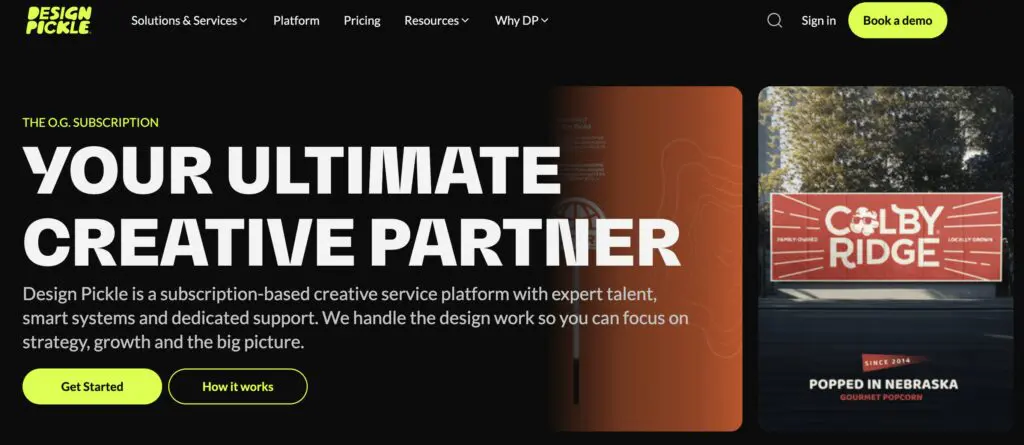
Design Pickle is often compared directly with Penji because both are built around unlimited design subscriptions. The difference lies in emphasis. Design Pickle focuses more narrowly on graphic design consistency and process maturity, making it appealing to teams that value standardized output over flexibility.
- Established design-only workflows
- Strong emphasis on consistency and turnaround discipline
- Large designer pool optimized for marketing assets
Penji vs Design Pickle: Penji prioritizes accessibility and entry pricing, while Design Pickle emphasizes design throughput and operational scale. Design Pickle fits better when design volume and consistency outweigh cost sensitivity.
Kimp
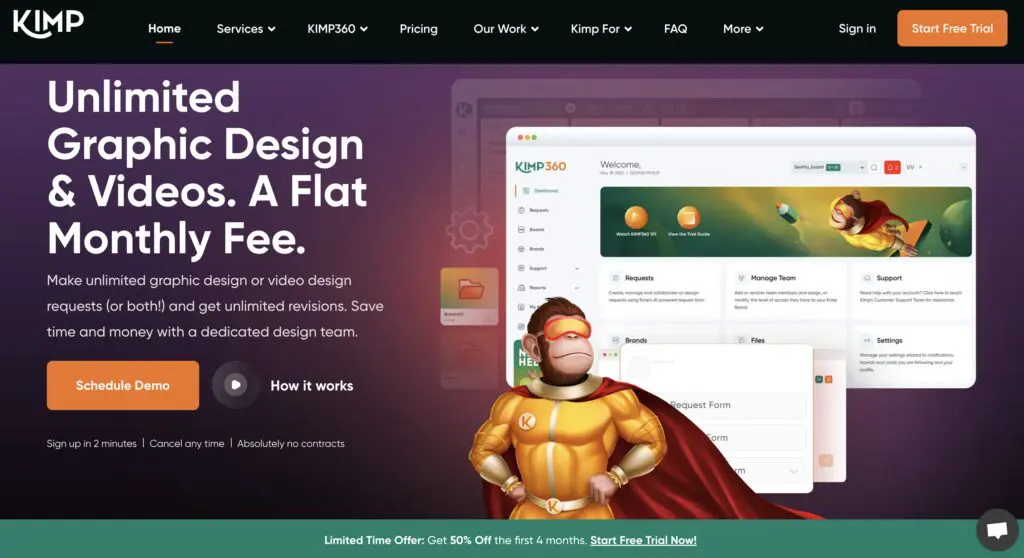
Best for: Agencies and marketing teams producing both graphic assets and basic video content.
Kimp enters the decision set when Penji’s design-only model starts to feel limiting. Teams choose Kimp when video becomes a regular part of the content mix and managing separate services introduces friction. It trades some simplicity for broader creative coverage.
- Graphic design and video editing under one subscription
- Predictable request-based workflow
- Suitable for multi-channel marketing output
Penji vs Kimp: Penji remains simpler and more budget-accessible for design-only needs. Kimp makes more sense when video is a recurring requirement rather than an occasional add-on.
How to Choose Between Penji and Alternatives
Calculate monthly design volume from last quarter. Divide total projects by three for baseline.
- Below 5 projects monthly: Freelancers cost less. At $50-$75 hourly, 4 projects run $400-$600 versus Penji’s $499.
- 5-10 projects monthly: Penji Starter justifies cost. Single concurrent capacity handles this volume adequately.
- 10-15 projects monthly: Upgrade to Marketer ($995) or choose Kimp ($995) for dual concurrent tasks and included video.
- Above 15 projects monthly: Penji’s 2 concurrent limit creates bottlenecks. Stack subscriptions or choose services with higher concurrent capacity.
Match Service Scope to Actual Needs
- Graphics only, no web work: Penji Starter at $499 or Design Pickle for higher throughput emphasis.
- Graphics + basic web design (Figma): Penji Marketer at $995 delivers static designs without development.
- Graphics + functional websites: Buzzcube integrates design with landing page and website development. Better than paying for Penji’s higher tiers without implementation.
- Graphics + video regularly: Kimp at $995 includes both without tier restrictions. Penji locks video behind $1,497 Agency plan.
Assess Workflow Patterns
- Steady weekly requests with clear briefs: Penji’s sequential processing works well.
- Multiple simultaneous deadlines: Single concurrent at Starter creates delays. Need Marketer tier or competitors with higher concurrency.
- Campaign-driven bursts: Subscription economics fail. Pay for unused capacity between campaigns.
Decision Summary
- Choose Penji Starter ($499) when: Design-only needs, volume hits 5-8 monthly, single concurrent capacity sufficient, budget prioritized.
- Choose Penji Marketer ($995) when: Need web design (Figma), infographics, presentations, and 2 concurrent projects justify upgrade.
- Choose Buzzcube when: Graphics and functional website development are primary needs. Design-to-implementation workflow matters more than asset-only output.
- Choose Kimp when: Video and graphics both needed regularly. $995 includes both without tier restrictions Penji imposes.
- Choose Design Pickle when: High-volume design consistency matters more than entry pricing. Established workflows and throughput discipline valued.
Skip subscriptions if volume is below 5 monthly, sporadic needs, or requires strategic creative direction services don’t provide.
Final Verdict
Penji is not the best unlimited design service in general terms. It is a reliable and accessible one for a specific type of work. When used as a steady production utility, it performs exactly as its reviews suggest. When expected to behave like something else, it predictably disappoints.
In 2026, Penji remains a sensible option for teams that understand those boundaries and plan their workflows accordingly.
For design-first teams needing web execution, Buzzcube specializes in unlimited graphic design with integrated landing page and website development, serving startups building conversion-focused digital assets rather than just design files.
Frequently Asked Questions
Is Penji worth it in 2026?
Worth it for teams producing 5-10 graphics monthly at Starter tier, or 10-15 when utilizing Marketer features. Not worth it below 5 monthly projects or when video/web development needs exist that require expensive tier upgrades.
What’s better than Penji for startups?
Depends on needs. Buzzcube better when web development matters alongside design. Kimp better when video is regular requirement. Penji better when budget-constrained and design-only needs sufficient.
Does Penji include web development?
No. Penji Marketer tier includes web design in Figma (static mockups) but no development or functional websites. Teams needing implementation require separate developers or services like Buzzcube with integrated development.
How does Penji compare to Design Pickle?
Penji starts cheaper ($499 vs Design Pickle’s higher entry) and includes broader features at mid-tier. Design Pickle emphasizes design consistency and throughput discipline. Choose Penji for accessibility, Design Pickle for established high-volume workflows.
Can Penji handle video editing and motion graphics?
Only at Agency tier ($1,497/month). Video locked behind highest pricing. Kimp includes video at $995 combined plan. Choose Penji only if video is secondary need, Kimp when video matters equally.
Is Penji’s 30-day guarantee actually risk-free?
Yes. Full refund within first 30 days if unsatisfied. Most competitors offer 7-14 day trials or no refunds. Makes Penji lower-risk for testing subscription model viability.