AI generated content is no longer a small part of the internet. It now makes up more content online than text written entirely by humans. Blog posts, student essays, product descriptions, social media posts, and even news drafts are increasingly created or assisted by AI tools such as ChatGPT and similar models.
As AI writing becomes more common, the challenge is no longer detecting rare misuse. The challenge is understanding when AI was used, how much it influenced the final text, and whether that use is acceptable in a given context.
The Copyleaks AI checker is one of the platforms designed to address this need. It aims to identify AI generated and AI assisted text while reducing the risk of flagging real human writing by mistake.
This article reviews the Copyleaks AI checker in practical terms. It explains what Copyleaks is, what tools it offers, how its AI detector works, how accurate it is, how it compares to other AI detection tools, and whether its pricing makes sense for different types of users.
What Is Copyleaks AI Checker?
Copyleaks is an online tool used to check whether content is original or generated by AI. It is best known for its Copyleaks AI checker, which helps identify text written by AI models such as Gemini, ChatGPT, Claude, Grok and similar systems.
The Copyleaks AI detector does not claim to prove who wrote a text. Instead, it analyzes the writing and estimates how likely it is that AI was involved. This makes it useful for reviewing essays, blog posts, articles, and other long form content where AI assistance may not be clearly disclosed. Copyleaks is widely used in education, publishing, SEO, and business environments.
How the Copyleaks AI Detector Works
The Copyleaks AI detector looks at how text is written rather than what it is about. AI generated writing tends to follow predictable patterns, while human writing usually shows more variation.
Copyleaks compares these patterns against large datasets of verified human written text and AI generated content. Based on this comparison, it estimates how likely it is that AI was involved in creating the text.
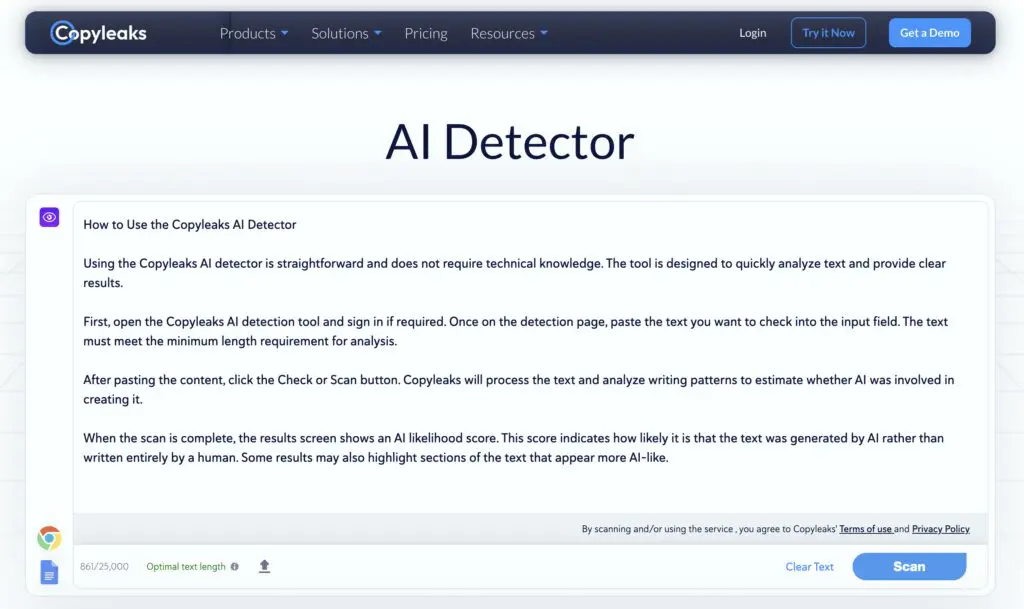
The tool does not make final decisions. Instead, it provides a likelihood score and sensitivity options that help reviewers decide whether content can be accepted, needs closer review, or requires further investigation. This approach helps reduce false positives and supports responsible use of AI plagiarism detection.
Copyleaks Accuracy Tests and Results
Copyleaks publicly explains how its AI detector is tested, which is uncommon in this space. Accuracy testing is done internally by two separate teams to reduce bias and improve reliability.
To keep testing fair:
- Test data is different from training data
- Human written texts come from verified sources, including material written before modern AI tools existed
- AI generated texts are created using multiple AI models
- All testing is done through the same API customers use
Large datasets are used, with hundreds of thousands of human and AI texts included in testing. Only longer texts are tested, since very short content is harder for any detector to classify accurately.
Across testing, the Copyleaks AI detector shows strong performance in two critical areas:
- Correctly identifying AI generated text
- Correctly recognizing human written text without mislabeling it
This second point is especially important. In previous AI detector reviews, we’ve seen that many AI detection tools struggle with false positives, where real human writing is incorrectly flagged as AI. Copyleaks focuses heavily on minimizing this risk, which makes it safer for use in education, publishing, and legal or compliance-sensitive environments.
Copyleaks vs Other AI Detection Tools
AI detection tools are built for different use cases, and not all of them offer the same features. The table below compares Copyleaks AI checker with other commonly used AI detection tools.
Feature | Copyleaks AI Checker | GPTZero | Originality.ai | Turnitin AI Detection |
AI content detection | Yes | Yes | Yes | Yes |
Plagiarism detection included | Yes, as a separate tool | No | Yes | Yes |
Multi-language support | Yes (over 30 languages) | Primarily focused on English use cases | Primarily English focus | Yes (via similarity database) |
Designed for education | Yes | Yes | Partial | Yes |
API access / integrations | Yes | Limited | Yes | Institutional LMS integration |
Key Takeaways from the Comparison
- All listed tools offer AI content detection, but they differ in scope and intended use.
- Copyleaks provides AI detection and plagiarism detection as separate tools within the same platform.
- GPTZero focuses only on AI text detection and does not include plagiarism checking.
- Originality.ai combines AI detection and plagiarism checking in a single workflow, commonly used by SEO and publishing teams.
- Turnitin integrates AI detection into its plagiarism system and is primarily used in academic institutions.
- The main differences between these tools relate to how results are delivered, whether plagiarism detection is included, and the environments they are designed for.
Pros and Cons of Copyleaks AI Checker
Pros
High AI detection accuracy supported by large scale testing
The Copyleaks AI checker has been tested on hundreds of thousands of human written and AI generated texts. According to published testing data, the Copyleaks AI detector shows strong accuracy in distinguishing between human content and AI generated text across multiple language models.
Low risk of false positives on human writing
A major strength of the Copyleaks AI checker is its low false positive rate. Human written texts are rarely mislabeled as AI generated, which is critical for academic integrity, publishing decisions, and professional content review.
Multiple sensitivity levels for different use cases
The Copyleaks AI detector offers adjustable sensitivity settings. Conservative modes prioritize protecting human writing, while more sensitive modes help identify AI generated text that has been edited or rewritten. This makes the tool adaptable across education, SEO, and enterprise workflows.
More reliable on mixed AI and human content
Compared to many AI plagiarism detection tools, Copyleaks handles hybrid content more consistently. While no detector is perfect, Copyleaks is less likely to fail when AI generated text has been partially rewritten by a human.
Part of a broader content integrity platform
The Copyleaks AI checker is integrated with the Copyleaks plagiarism checker, AI image detection, and text moderation tools. This allows teams to manage multiple content risks from a single platform rather than relying on separate tools.
Built for professional and enterprise use
Copyleaks supports API access, reporting, and scalable workflows. This makes it suitable for universities, publishers, SEO agencies, and businesses reviewing large volumes of content.
Cons
AI detection results are probabilistic, not definitive
Like all AI content detection tools, the Copyleaks AI checker provides likelihood based results rather than absolute proof. Human review is still required, especially in high stakes situations.
Short content is difficult to evaluate reliably
The Copyleaks AI detector requires a minimum text length to produce meaningful results. Very short content may not be accepted or may lead to less reliable classification.
Heavily rewritten AI content can reduce confidence scores
Advanced rewriting or humanization can lower detection confidence. This limitation applies to all AI plagiarism detection tools, including Copyleaks.
Pricing may not suit occasional users
Copyleaks pricing is designed for professional and organizational use. Individuals who only need occasional checks may find the cost higher than simpler tools.
Requires interpretation rather than instant answers
The Copyleaks AI checker does not deliver a simple yes or no result. While this supports responsible use, it may feel less convenient for users seeking quick decisions.
Other Copyleaks Tools Available on the Platform
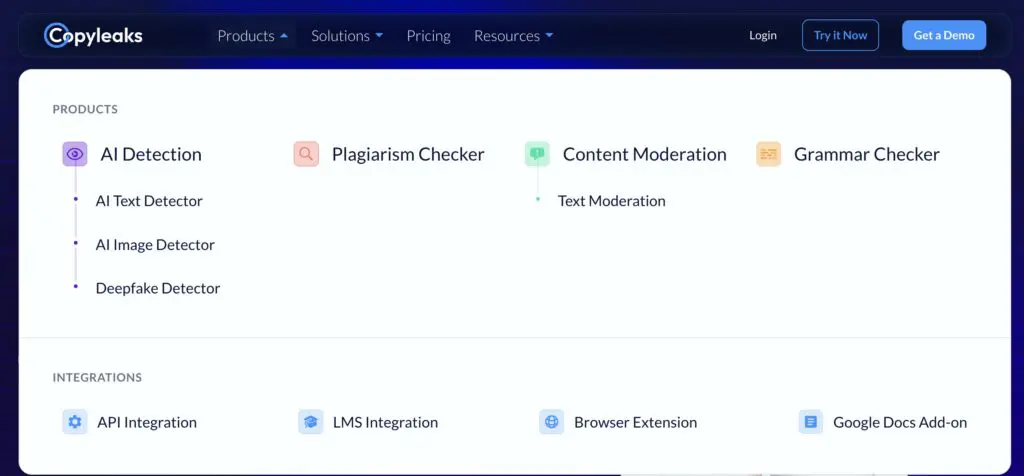
In addition to the Copyleaks AI checker, the platform includes several tools designed to support content quality, originality, and compliance across text and visual media.
AI Image Detection
Copyleaks AI image detection helps identify whether an image was created using generative AI. As AI generated images become more common in marketing and online content, this tool supports teams that need to verify image authenticity before publishing. It is especially useful for publishers, educators, and brands that rely on original visual content.
Text Moderation Tool
The Copyleaks text moderation tool analyzes written content for harmful, unsafe, or policy-violating language. It helps organizations moderate user generated content, customer messages, and public facing text at scale. This is commonly used in platforms where content safety and compliance are required.
Plagiarism Checker
The Copyleaks plagiarism checker compares text against a large database of web pages, academic sources, and proprietary content. It detects copied and closely paraphrased material, helping ensure originality and prevent copyright issues. This tool is widely used in education, publishing, and professional content workflows.
Grammar Checker
The Copyleaks grammar checker reviews text for spelling, grammar, and basic readability issues. While not a replacement for advanced writing assistants, it helps clean up content before running plagiarism or AI detection checks, improving overall content quality.
Is Copyleaks the Best AI Content Detection Tool in 2026?
No AI content detection tool can be considered “the best” in an absolute sense. AI generated text continues to evolve, and as language models improve, detection becomes more complex. Every detector, including Copyleaks, works on probabilities rather than certainty.
AI detection tools are best understood as support systems, not decision makers. They can highlight patterns, flag risk, and provide useful signals, but they cannot definitively prove authorship on their own. Treating any tool as a final authority increases the risk of incorrect conclusions, especially when content has been edited or written with care.
More importantly, focusing only on whether content is AI generated misses the larger issue. The real goal should be content quality, originality, and usefulness. Well written, accurate, and ethical content matters far more than whether AI assisted in its creation. In many professional environments, responsible AI use is already accepted, as long as the final output meets quality and integrity standards.
Frequently Asked Questions
What is the Copyleaks AI checker?
The Copyleaks AI checker is an AI content detection tool that estimates whether a piece of text was written by a human or generated by artificial intelligence. It analyzes writing patterns and assigns a likelihood score rather than giving a simple yes or no result.
How accurate is Copyleaks at detecting AI content?
Copyleaks is considered one of the more accurate AI detection tools available. According to published testing, the Copyleaks AI detector shows high accuracy in identifying AI generated text while keeping false positives on human writing very low. Like all AI detectors, results are probabilistic and should be reviewed in context.
Can Copyleaks detect ChatGPT and other AI models?
Yes. The Copyleaks AI checker is designed to detect content generated by popular AI models, including ChatGPT, GPT-4, Claude, Gemini, and similar large language models. Detection accuracy may vary depending on how much the text has been edited by a human.
Is Copyleaks better than GPTZero?
Copyleaks and GPTZero use different approaches. Copyleaks places stronger emphasis on reducing false positives and supporting professional use cases, while GPTZero is often used for quick checks. Copyleaks vs GPTZero comparisons usually favor Copyleaks in environments where accuracy and caution are more important than speed.
Does Copyleaks also check for plagiarism?
Yes. In addition to AI detection, Copyleaks includes a plagiarism checker that compares text against web sources, academic databases, and proprietary content. This helps users check both originality and potential AI involvement in the same platform.
Can Copyleaks detect partially edited or humanized AI content?
Copyleaks can detect AI generated content that has been lightly or moderately edited. However, heavily rewritten or deeply humanized text may reduce detection confidence. This limitation applies to all AI plagiarism detection tools, not just Copyleaks.
Is Copyleaks suitable for SEO content?
Yes. Copyleaks is commonly used by SEO teams and agencies to review AI generated and hybrid content before publication. It helps assess risk but should not be used to judge content quality or search performance.
Does Copyleaks work on short text?
Copyleaks requires a minimum text length to analyze content accurately. Very short text samples may not be accepted or may produce less reliable results, which is common among AI content detection tools.
Is Copyleaks free to use?
Copyleaks offers limited free access for testing. Full AI detection and plagiarism checking require a paid plan, with pricing based on usage and features.
Can Copyleaks be trusted as final proof of AI use?
No. Copyleaks should not be used as final proof. Like all AI detection tools, it provides likelihood based results that should support human review rather than replace it.