
Choosing the right bank plays a direct role in how a small business manages cash flow, controls costs, and accesses credit. In 2026, small business banking looks very different from even a few years ago. Rising fees at traditional banks, improved digital tools from online banks, and faster payment expectations have expanded the range of viable options.
Many businesses continue using a bank chosen years earlier without reassessing whether it still fits their operating model. As transaction volumes increase and costs add up, that choice can quietly limit growth.
This guide breaks down the best banks for small businesses in 2026, explains the differences between traditional and online banks, and outlines how to choose the right business bank account based on actual needs rather than brand recognition.
Quick Picks: Best Banks for Small Businesses in 2026
- Best overall small business bank: Chase
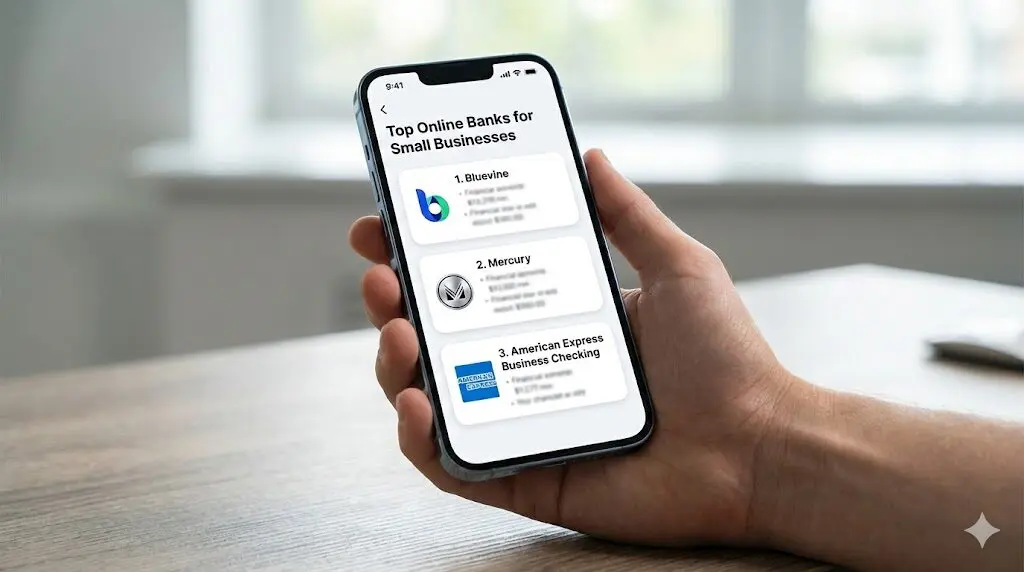
- Best online bank for small businesses: Bluevine
- Best for startups and SMBs: Mercury
- Best for interest-bearing business checking: American Express Business Checking
- Best traditional bank with nationwide access: Bank of America
- Best low-fee traditional option: U.S. Bank
Traditional vs Online Business Banks
Factor | Traditional Banks | Online Banks |
Branch Access | Physical locations nationwide | Digital-only, no branches |
Monthly Fees | $10-$40 typical | Often $0 |
Checking APY | 0.01-0.05% | 1.0-2.0%+ |
Cash Deposits | Easy in-branch | Very limited options |
Transaction Limits | 100-500/month | Often unlimited |
Loan Access | In-person lending relationships | Competitive but digital-only |
Setup Time | Days, requires branch visit | Minutes, fully online |
Customer Service | Personal banker assigned | Phone/chat support |
When Traditional Banks Work Best
Businesses depositing cash daily need physical branches. A restaurant depositing $3,000 in cash receipts each day wastes hours driving to special deposit locations that online banks provide. Traditional bank branches handle this in five minutes.
Companies building lending relationships benefit from face-to-face banker access. A banker who knows the business, sees regular deposits, and understands the industry approves loans faster and at better rates than algorithms reviewing applications from businesses they’ve never met.
Multi-location operations gain efficiency from branch networks. Depositing at any branch, obtaining cashier’s checks locally, and resolving issues in person keeps operations moving. Online banks force everything through phone support, which takes longer for complex situations.
Businesses requiring merchant services, payroll processing, and banking from one provider simplify operations through traditional banks. Coordinating between separate providers for each service creates unnecessary complexity.
When Online Banks Work Best
Service businesses without cash deposits pay for branch networks they never use. A consulting firm, software company, or marketing agency conducting all business electronically gains nothing from Chase’s 4,700 branches while paying $180 annually in fees that online banks eliminate.
The interest rate difference matters significantly for businesses maintaining substantial checking balances. A company keeping $75,000 in checking earns $1,500 annually at 2.0% versus $7.50 at traditional bank rates. That $1,500 difference compounds over years.
Startups moving fast need accounts opened immediately. Traditional banks require appointments, physical document verification, and wait periods. Online banks approve accounts in minutes, enabling same-day operation.
Digital tools work better at online banks built on modern technology. Mobile apps designed this decade integrate smoothly with QuickBooks, Stripe, and other business software. Legacy bank systems often create friction despite recent improvement efforts.
Best Traditional Banks for Small Businesses
Chase: Best Overall Traditional Bank
Chase provides the most comprehensive traditional small business banking through nationwide branch access, extensive products, and lending capabilities. Businesses from sole proprietors to 50-employee companies find appropriate account tiers and services.
Key features:
- 4,700 branches across all states for cash deposits and in-person service
- Chase Business Complete Banking with QuickBooks integration
- Ink business credit cards offering cash back and rewards
- Chase QuickAccept payment processing without separate merchant accounts
- Business banking specialists in most branches
- Business lines of credit and term loans with relationship pricing
- Zelle for Business for instant vendor and contractor payments
Best for: Retail businesses depositing cash daily, multi-location operations needing consistent service, companies building lending relationships for expansion, businesses requiring integrated merchant services and payroll
Fees snapshot: $15 monthly, waived with $2,000 minimum daily balance or $15,000 average balance. 20 free transactions monthly, then $0.40 each. Reasonable cash deposit allowances before fees apply.
Consider if: The business operates entirely online without cash. Paying $180 annually for branch access that never gets used wastes money. Online banks provide the same digital services at zero cost for businesses that don’t need physical locations.
Bank of America: Best for Integrated Services
Bank of America connects banking, credit cards, and merchant services through tiered accounts that scale with business growth. The Preferred Rewards for Business program provides significant value for companies using multiple Bank of America products.
Key features:
- 3,900 branches across 37 states
- Three checking tiers from basic to sophisticated operations
- Preferred Rewards for Business with up to 75% credit card rewards bonus
- Business Advantage 360 platform for cash flow management
- Zelle integration for fast business payments
- Combined personal and business relationship benefits
- Cash flow forecasting tools
Best for: Businesses optimizing rewards across banking and credit products, companies already using Bank of America personally, operations needing scalable account options, businesses prioritizing digital tools alongside branch access
Fees snapshot: $16 monthly for Fundamentals, $29.95 monthly for Preferred. Waivers available based on balances or combined relationships. Transaction limits vary from 200 to 500 monthly by tier.
Consider if: Maintaining $5,000 to $25,000 minimum balances proves difficult. Without meeting waiver requirements, fees reach $192 to $360 annually. Better value exists elsewhere for businesses that can’t maintain these balances.
U.S. Bank: Best Value Traditional Bank
U.S. Bank delivers traditional banking at lower costs than Chase or Bank of America. The Silver Business Checking account provides solid value for businesses wanting branch access without premium pricing.
Key features:
- 2,200 branches across 26 states, concentrated in Midwest and West
- Silver Business Checking with 125-150 free monthly transactions
- Significantly lower fees than national megabanks
- Free business debit card and mobile deposit
- Business credit cards with cash back, no annual fees
- Competitive small business loan rates
- Instant card issuance for immediate account access
Best for: Cost-conscious businesses in U.S. Bank’s regional footprint, companies wanting branch access at reasonable prices, operations processing moderate transaction volumes, businesses prioritizing value over brand names
Fees snapshot: $0 monthly for low-volume accounts, $6.95 monthly for Silver Business Checking. Transaction limits of 125-150 monthly suit most small businesses without triggering excess fees.
Consider if: Operations span regions beyond U.S. Bank’s coverage. The regional footprint serves the Midwest and West well but lacks true nationwide reach. Businesses operating across all regions need broader networks.
Best Online Banks for Small Businesses
Bluevine: Best Online Bank Overall
Bluevine eliminates the checking versus savings trade-off by paying up to 2.0% APY on checking balances while charging zero monthly fees. This structure works perfectly for businesses keeping operating capital accessible.
Key features:
- Up to 2.0% APY on checking balances
- Zero monthly fees, no minimum balance requirements
- Unlimited transactions without limits or excess fees
- Integrated invoicing with automated payment collection
- Business line of credit up to $250,000
- Free incoming wire transfers
- Mobile check deposit and bill pay included
Best for: Digital businesses without cash deposits, service companies maintaining higher checking balances, startups minimizing banking costs, businesses prioritizing interest earnings on operating capital
Fees snapshot: $0 monthly fees. 2.0% APY on checking balances. FDIC insured through Coastal Community Bank. Free business debit card.
Consider if: Cash deposits happen regularly. Online banks make cash deposits extremely difficult, requiring workarounds like depositing to personal accounts first or using money order services. Cash businesses need traditional banks.
Mercury: Best for Startups and Tech Companies
Mercury targets VC-backed startups with features designed specifically for technology companies. Treasury management, investor reporting, and startup ecosystem integration differentiate Mercury from general business banks.
Key features:
- Zero monthly fees on all accounts
- Treasury accounts earning up to 4.85% APY on reserves
- Virtual and physical debit cards with spending controls
- Multi-currency accounts for international operations
- Integration with Carta, Brex, Ramp, Pulley
- Investor-ready financial reporting
- Venture debt and growth financing partnerships
Best for: VC-backed startups raising capital, technology and SaaS companies, businesses with international contractors, companies needing investor reporting, operations requiring treasury management across multiple accounts
Fees snapshot: $0 monthly fees. Competitive APY on treasury accounts. FDIC insured through Choice Financial Group and Evolve Bank & Trust.
Consider if: The business operates outside technology and startups. Mercury’s features target fast-growth tech companies raising venture capital. Traditional businesses find limited value in features designed for completely different operations.
American Express: Best for Interest-Bearing Checking
American Express combines competitive checking account interest with the brand’s customer service reputation. This works well for businesses maintaining substantial checking balances.
Key features:
- Competitive APY on checking balances
- Zero monthly fees, no minimum requirements
- Unlimited transactions without excess fees
- American Express Business credit card integration
- Mobile check deposit and bill pay
- Overdraft protection options
- Strong fraud protection and dispute resolution
Best for: Businesses using American Express credit cards, service companies benefiting from checking account interest, operations wanting brand recognition with online banking efficiency, businesses prioritizing customer service quality
Fees snapshot: $0 monthly fees. Competitive APY varies with market rates. FDIC insured through Coastal Community Bank.
Consider if: Heavy accounting software integration is critical. American Express Business Checking offers fewer third-party integrations than Bluevine or Mercury. Businesses relying on automated QuickBooks or Xero connections may find functionality gaps.
Understanding Small Business Banking Fees
Fee structures hide costs beyond advertised monthly charges. True costs emerge after accumulating transaction fees, cash deposit charges, and wire transfers over months.
Common fees and typical costs:
- Monthly maintenance: $0-$40, waived with $2,000-$25,000 minimum balances
- Transaction fees: $0.30-$0.50 per transaction after 100-500 monthly limit
- Cash deposits: $0.10-$0.30 per $100 deposited (a restaurant depositing $10,000 weekly pays $52-$156 monthly)
- Wire transfers: $15-$30 domestic, $35-$50 international
- Overdraft: $25-$36 per occurrence
- ATM: $2-$3 per out-of-network withdrawal
Avoiding fees:
Maintain minimum balances for waivers when feasible. Choose online banks with $0 maintenance fees for digital businesses. Monitor transaction counts and upgrade tiers before exceeding limits. Use in-network ATMs only. Link personal and business accounts for combined relationship benefits at some banks. Consider credit unions charging $5-$15 monthly versus $15-$40 at traditional banks.
How to Choose the Best Small Business Bank Account
Match Banking to Business Operations
- Cash-heavy retail or restaurants need traditional banks with branch networks for daily deposits.
- Digital service businesses benefit from online banks with $0 fees and higher interest rates.
- VC-backed startups need Mercury or similar platforms understanding fundraising cycles and investor reporting.
- Freelancers and solo operations need simple accounts like Novo or Bluevine with integrated invoicing.
- Scaling SMBs need traditional banks offering lending relationships and integrated services.
Calculate Real Monthly Costs
Add base fees plus transaction fees (if exceeding limits) plus cash deposit fees plus wire transfer costs. Subtract realistic fee waivers based on actual maintained balances.
A bank advertising $15 monthly might cost $45 with fees. Compare true costs, not advertised rates.
Test Before Opening
Download mobile apps and test functionality. Verify accounting software integration with QuickBooks or Xero. Call support with questions to assess response quality.
Plan for Growth
Consider lending needs in 12-24 months, employee hiring requiring payroll integration, multi-location expansion, and international operations. Choose banks supporting 3-year plans, not just current needs.
Final Verdict: The Best Bank Depends on How Your Business Operates
The best banks for small businesses in 2026 depend on how a business handles transactions, manages cash, and plans to grow. Online banks provide lower fees and modern tools, while traditional banks offer in-person service and lending relationships.
Choosing intentionally based on operations rather than habit leads to better financial outcomes. Regularly reassessing banking needs ensures the chosen bank continues to support the business as it evolves.
Frequently Asked Questions
What is the best bank for a small business in 2026?
Chase leads for traditional businesses needing branches and full services. Bluevine excels for digital businesses prioritizing zero fees and interest earnings. Mercury serves VC-backed startups best. U.S. Bank provides best value among traditional options. The right choice depends on business model, cash handling, and growth plans.
Are online banks safe for small businesses?
Online banks with proper FDIC insurance are safe. Bluevine, Mercury, and American Express partner with FDIC-insured banks protecting deposits up to $250,000 per account. Online banks often provide stronger security through modern technology, two-factor authentication requirements, real-time fraud monitoring, and instant transaction alerts.
What is the best business checking account with no monthly fees?
Bluevine, Mercury, Novo, and American Express Business Checking charge zero monthly fees without minimum balance requirements. Bluevine adds up to 2.0% APY on checking balances. These suit digital businesses minimizing costs while earning interest on operating capital.
Can a small business have multiple bank accounts?
Multiple accounts improve operations for many businesses. Common strategies include primary checking at one bank, high-yield savings at an online bank for reserves, and separate payroll accounts simplifying compliance. Multiple accounts help with budget management, provide backup during technical issues, and optimize different banks’ strengths.
When should a business switch banks?
Switch when fees exceed value provided, customer service deteriorates, the bank can’t support growth, better options emerge with higher rates or lower fees, the business model shifts, or geographic expansion requires different coverage. Switching takes 2-4 weeks. Plan during slower periods to minimize disruption.