
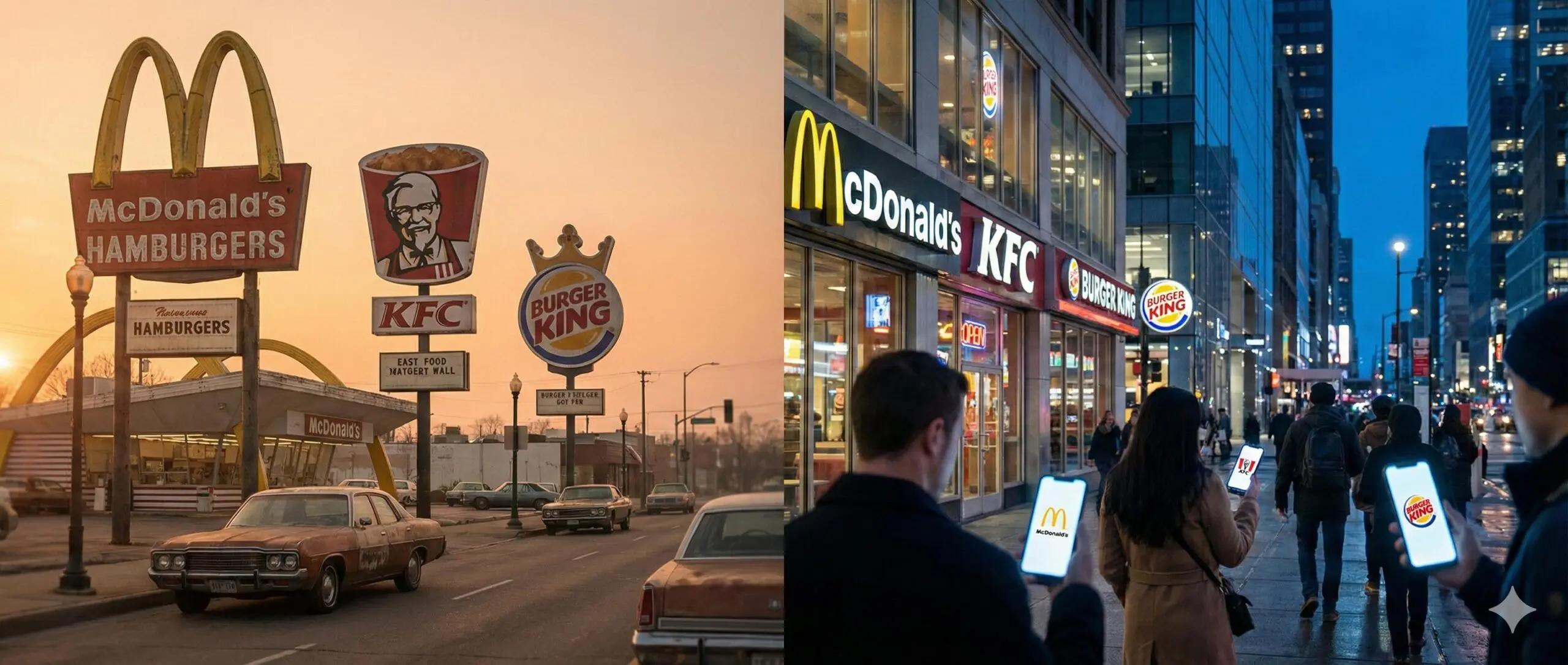
The evolution of fast-food logos is a chronological record of shifting design priorities: from hand-drawn mascots optimized for roadside signage, to modular vector marks engineered for tiny app icons and animated UI systems.
This article examines fast food logo history across four design eras, analyzes logo redesign trends behind famous food brand logos, and extracts branding lessons from fast food that apply to modern restaurant branding design.
TL;DR 8 Key Shifts in Fast-Food Logo Evolution
- Mascot & illustration era (1920s–1960s): Character storytelling, hand-rendered marks.
- Franchising & reproducibility (1970s–1990s): Simplification for signage and packaging.
- Wordmark and corporate standardization: Typography as identity backbone.
- Digital minimalism (2000s): Flat aesthetics, silhouette-first thinking.
- Mobile-first optimization (2015–present): Favicons, app icons, circular crops.
- The Instagram Effect: Social formats forcing extreme micro-legibility.
- Globalization vs localization: System-based adaptations across markets.
- Brand systems & motion identity: Logos as components in flexible ecosystems.
Evolution of Design Priorities in Fast-Food Logos
This section follows a strict timeline framework, focusing on why visual changes happened, not merely what changed.
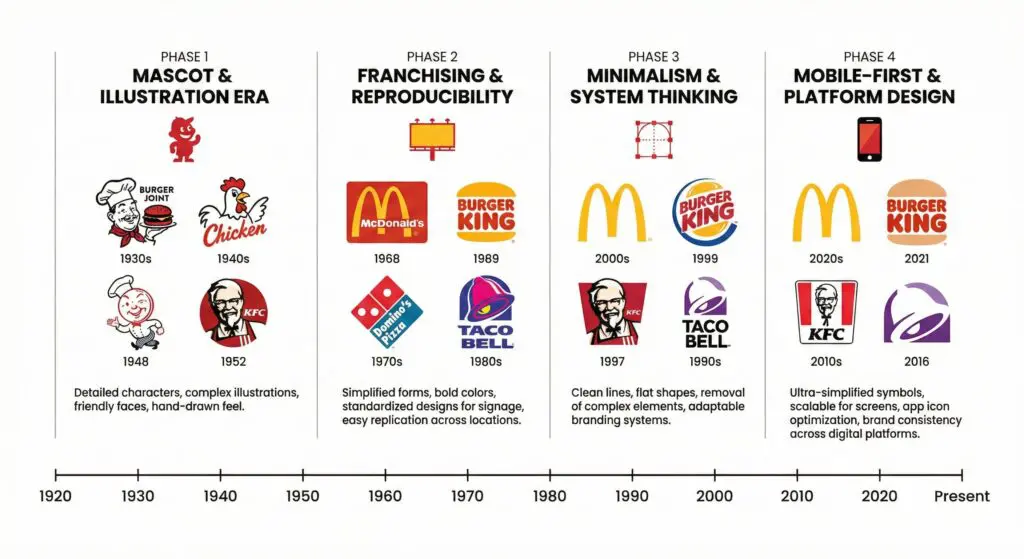
1. Mascots and Illustration (1920s to 1960s)
Early fast-food marks relied on detailed illustration and script type because brands communicated in physical spaces: storefront windows, menus, and local print. Mascots encoded personality and trustworthiness when the concept of “fast food” itself was new.
From a design standpoint, detail and ornamentation were acceptable because logos were intended to be read at the human scale, painted on boards, printed on paper, or embroidered on staff uniforms.
Design constraints included lithographic reproduction, hand lettering, and large-format signage. The mark functioned as a narrative device.
2. Franchising, Highways, and Reproducibility (1970s to 1990s)
As chains franchised nationally and internationally, the operational requirement for consistent reproduction became essential. Logos needed to read at a distance on highway billboards and at a small scale on menus and packaging. The response: geometric simplification, bolder strokes, high-contrast palettes, and standardized wordmarks.
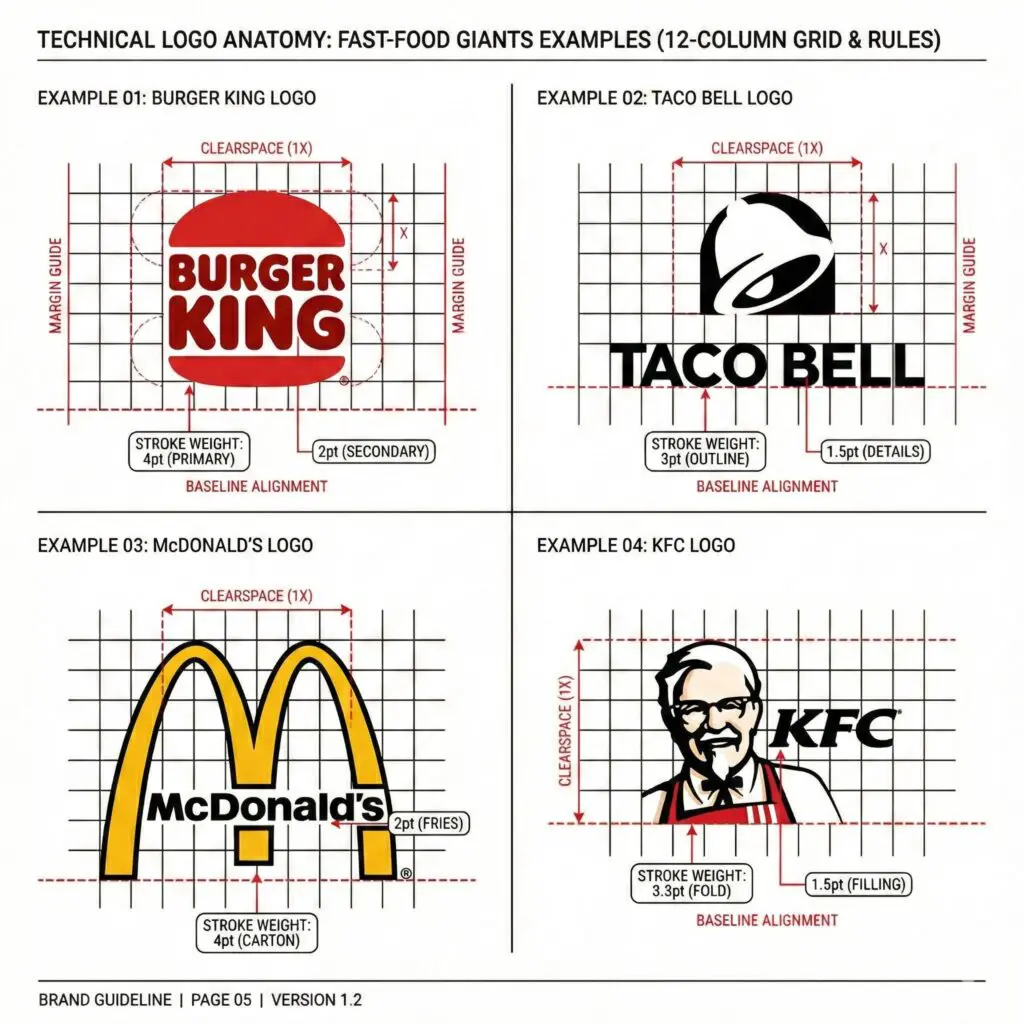
Design language shifted from narrative ornament to structural clarity. Spatial systems, like clearspace rules and corporate typefaces, became common, enabling consistent application across thousands of locations.
3. Minimalism and System Thinking (2000s)
With the rise of digital interfaces, glossy textures and photorealistic effects lost importance. Designers adopted flat, vector-based marks that scaled cleanly across screens.
Identity thinking matured. The logo became one element within a broader system that included packaging, environmental graphics, digital assets, and motion standards.
Technical priorities included single-color variants, SVG assets, grid-based geometry, and legibility across RGB displays. The logo shifted from static insignia to a component within a scalable brand system.
4. Mobile-First and Platform-Driven Design (2015 to Present)
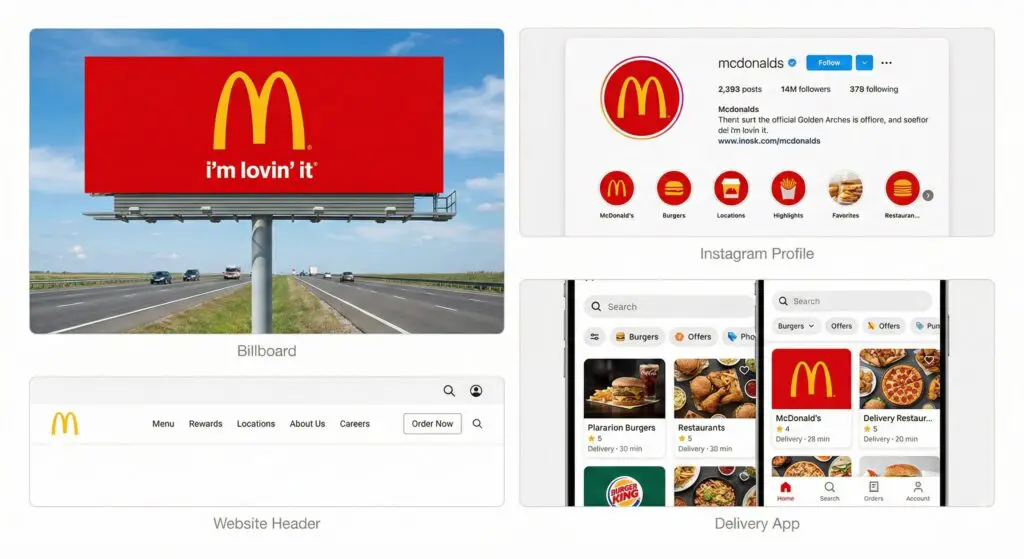
The most recent logo evolution phase is driven by smartphone and social platform constraints. App icons, favicons, and circular profile crops require extreme clarity at very small sizes. Motion and responsive behavior are now part of the design brief.
Practical priorities include reduced detail, thicker stroke weights, single focal elements, and strong contrast in low-resolution contexts. The business logic is simple. The logo must help users recognize the brand within crowded digital environments.
The Instagram Effect on Fast-Food Logos
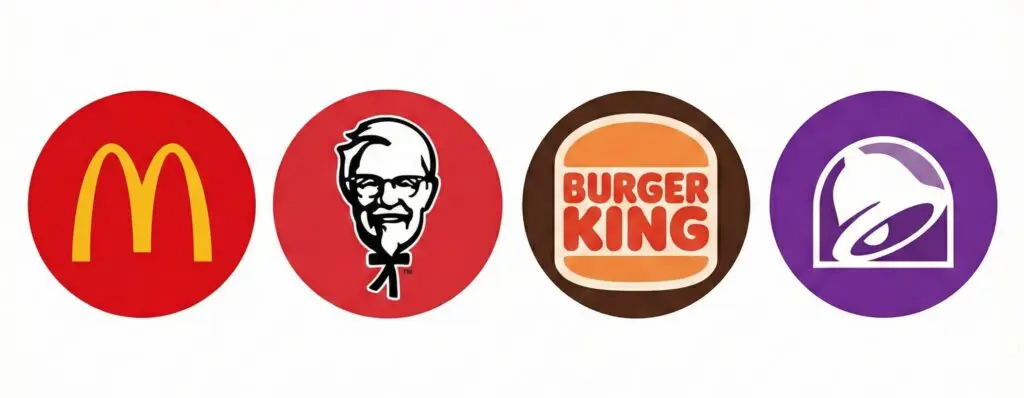
Thesis: Fast-food logos were redesigned not for billboards, but for phones.
Social platforms introduced formal constraints, square thumbnails, circular crops, and severe downscaling. that amplified existing digital pressures into design orthodoxy.
Platform constraints that matter
- Circular profile images: Logos must retain identity when tightly cropped to a circle; kerning and peripheral details are fragile.
- Favicons & tiny icons (16×16–32×32 px): Silhouette clarity, not detail, wins.
- Delivery app thumbnails & grids: Logos are viewed at a glance next to many competitors, contrast and distinct shapes aid quick recognition.
- Motion & animation: Micro-interactions become brand touchpoints requiring motion systems and vector sequences.
- Compression & color shifts: Social compression can muddy gradients; flat palettes survive better.
Design responses
- Move the focal element to an iconable shape.
- Tighten stroke weights and increase x-height for any accompanying wordmark.
- Provide single-color and reversed variants to survive dark mode and saturation changes.
- Build short motion specs for brand animation.
These constraints explain why fast-food logo redesigns emphasize silhouette, contrast, and systemization.
Case Studies: Design-Centric Analyses of Fast Food Logos
Each case study follows the same structure: chronology of changes, technical reasoning, digital adaptation, regional variability, and one distilled lesson.
McDonald’s Logo Evolution
From illustrated characters and Speedee to the modern Golden Arches, McDonald’s identity condensed into a single geometric form. Wordmarks shifted over time, but the arches became the dominant signifier.
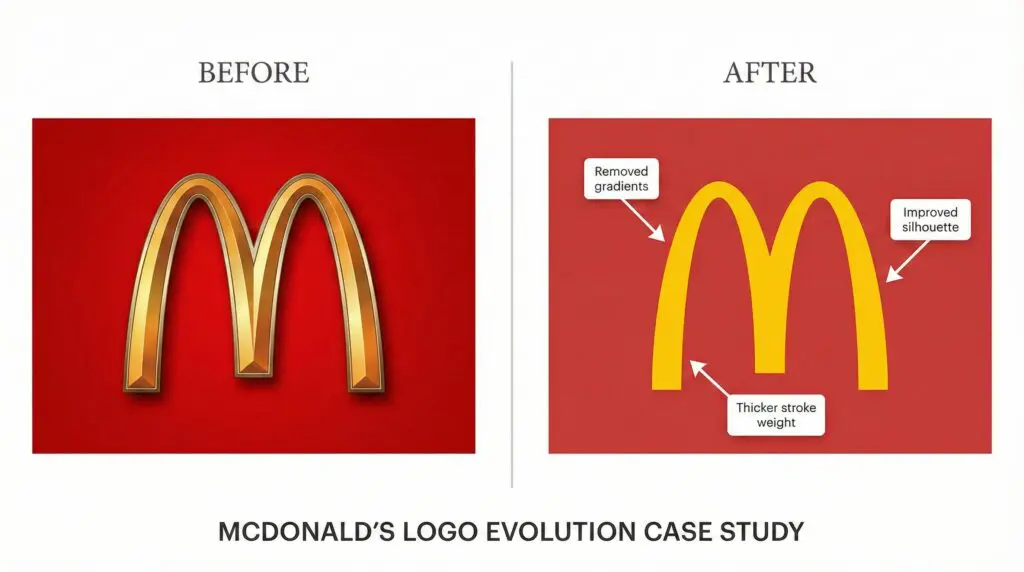
What Changed:
- Illustration Into Flat Vector Simplification
- Removed Gradients
- Improved silhouette
- Thicker Stroke Weight
- Digitally Adaptable For Apps and Social Media
Design reasoning: The arch is legible at a distance, reproducible in signage, and easily isolated for iconography. The system includes color reverses and compact monograms for small screens.
Digital adaptation: The arch performs effectively as an app icon or avatar without supporting text. Motion guidelines extend recognition into interactive contexts.
Localization: In some European markets, green environmental graphics are layered onto the arches, showing system flexibility while preserving geometry.
Lesson for graphic designers: Distill identity into a single geometric glyph that supports both static and animated use.
Burger King Logo Evolution
Burger King’s marks have alternated between literal burger imagery and abstract typographic treatments. The 2021 redesign returned to a simplified bun and wordmark combination that performs cleanly on digital platforms.
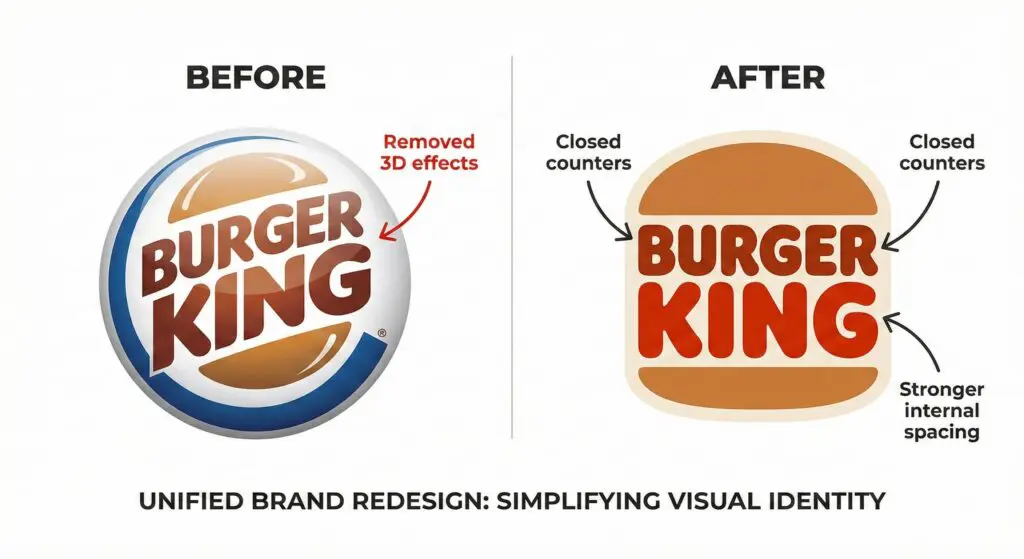
What Changed:
- Illustration into flat vector simplification
- Removed 3D effects
- Closed counters
- Strong internal spacing
- Digitally adaptable for apps and social media
Design reasoning: The geometry emphasizes internal spacing and rounded counters so the mark holds together at small sizes.
Digital adaptation: The bun silhouette serves as a compact icon for home screens and favicons.
Localization: Regional photography and color intensity vary, while bun geometry remains fixed.
Lesson for graphic designers: Prioritize internal spacing and closed counters to prevent fragmentation at micro scales.
KFC Logo Evolution
KFC’s identity centers on Colonel Sanders’ portrait, which has been redrawn repeatedly to balance detail with recognizability.
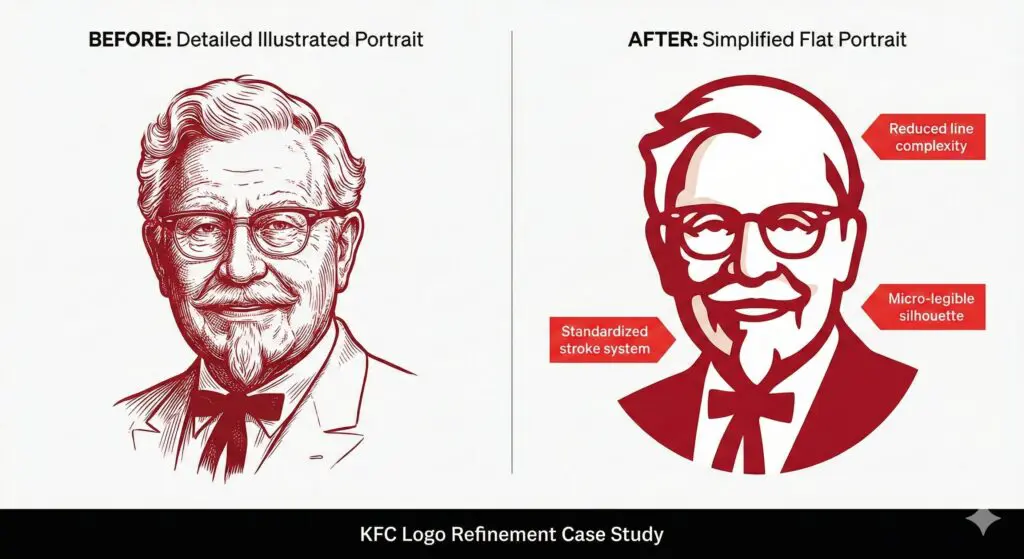
What Changed:
- Illustration into flat vector simplification
- Reduced line complexity
- Standardized stroke system
- Improved micro legibility
- Stronger silhouette
- Digitally adaptable for apps and social media
Design reasoning: Each iteration reduced line complexity and standardized stroke systems to create a reliable silhouette at small sizes. The portrait evolved from a detailed illustration to a simplified icon.
Digital adaptation: Single-color variants and compact lockups support favicons and delivery thumbnails.
Localization: Some markets favor typographic lockups or adjusted color usage while preserving the core portrait structure.
Lesson for graphic designers: When a logo includes detailed illustration, simplify the silhouette and rationalize stroke weight for digital clarity.
Taco Bell Logo Evolution
Taco Bell gradually transformed its bell motif logo from ornate to highly abstracted, gravitating toward a single-shape glyph.
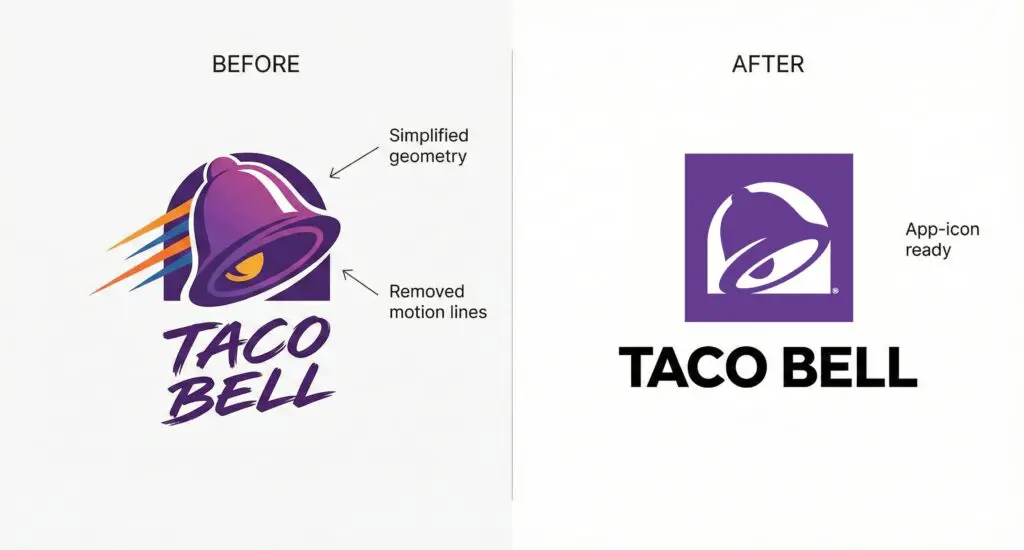
What Changed:
- Illustration into flat vector simplification
- Geometric simplified bell icon
- Removed motion lines
- Clean sans-serif typography
- Digitally adaptable for apps and social media
Design reasoning: Negative space and stroke proportions were optimized to remain legible inside circular crops.
Digital adaptation: The symbol functions as a compact app icon. Simple motion sequences, such as ringing or tilting, create animation flexibility.
Localization: Regional campaigns vary in photography and tone, while the bell silhouette remains central.
Lesson for graphic designers: Extract and refine a single negative-space shape that can scale across platforms.
10 Practical Branding Lessons from Fast Food Logos
- Design for 16px first. Test icons and wordmarks at favicon size before refining detail.
- Build a logo system with primary, secondary, and micro glyphs plus motion tokens.
- Enforce silhouette strength across sizes and grayscale tests.
- Standardize stroke weights for consistency across applications.
- Provide single-color variants for constrained digital contexts.
- Plan for animation early in the identity process.
- Localize color and photography intentionally while preserving core geometry.
- Set measurable contrast targets for UI legibility.
- Evaluate redesign performance through delivery app conversion and loyalty metrics.
- Document rollout governance to prevent inconsistent execution.
These principles emerge directly from the fast food logo history outlined above.
Disciplined Design, Measurable Outcomes
The evolution of fast-food logos reflects a recurring design challenge shaped by changing constraints. Each era rebalances priorities from storytelling to reproducibility, from systemization to platform optimization.
For modern brands, the lesson is procedural. Design for the most constrained environment first. Build flexible systems. Align visual evolution with strategic and operational change.
For teams looking to apply these principles without limits, Buzzcube.io offers unlimited graphic design services to help brands evolve seamlessly across every medium.
FAQs
Why are so many fast-food logos red and yellow?
Red and yellow provide high luminance contrast and are associated in behavioral studies with appetite and urgency, making them useful for visibility and call-to-action.
How has Instagram affected logo design?
Instagram and similar platforms force tight circular crops and micro sizes, prompting brands to favor single glyphs, flat palettes, and silhouette-driven marks.
What is the KFC logo evolution?
KFC refined the Colonel’s portrait into cleaner linework and single-color variants to maintain recognizability at small sizes while preserving heritage.
Do logo changes increase sales?
Alone, no. Logo redesigns often produce short-term attention; sustained revenue effects require alignment with product, distribution, and marketing strategies.
When should a restaurant redesign its logo?
When core brand positioning changes, when new platforms demand different assets, or when a legacy mark fails across necessary digital touchpoints.
How should brands manage global vs local identity?
Use a global skeletal system with approved local skins; this preserves recognition while allowing cultural relevance.