

Keyword research is the foundation of any successful SEO strategy. Without a clear understanding of what people search for, even the best content struggles to perform. Among all SEO keyword research tools available today, Ahrefs stands out for its depth of data, reliable metrics, and practical workflows that support real ranking decisions.
This guide explains how to approach keyword research with Ahrefs in a structured, repeatable way that leads to traffic growth, not just keyword lists.
Why Keyword Research with Ahrefs Matters
Effective SEO starts with choosing the right battles. Ahrefs helps identify keywords that are not only searched but also realistically rankable. Unlike basic tools that focus mainly on search volume, Ahrefs provides context through metrics like Keyword Difficulty, Traffic Potential, and SERP-level data. This allows SEO specialists to prioritize keywords that can actually drive results instead of chasing vanity metrics.
Using Ahrefs for SEO keyword research also reduces guesswork. Every keyword can be evaluated based on competition, intent, and expected traffic, which makes planning content and pages more predictable and scalable.
Understanding Ahrefs Keyword Explorer Fundamentals
Before applying filters or exporting data, it is critical to understand how Ahrefs Keyword Explorer works and what its metrics represent.
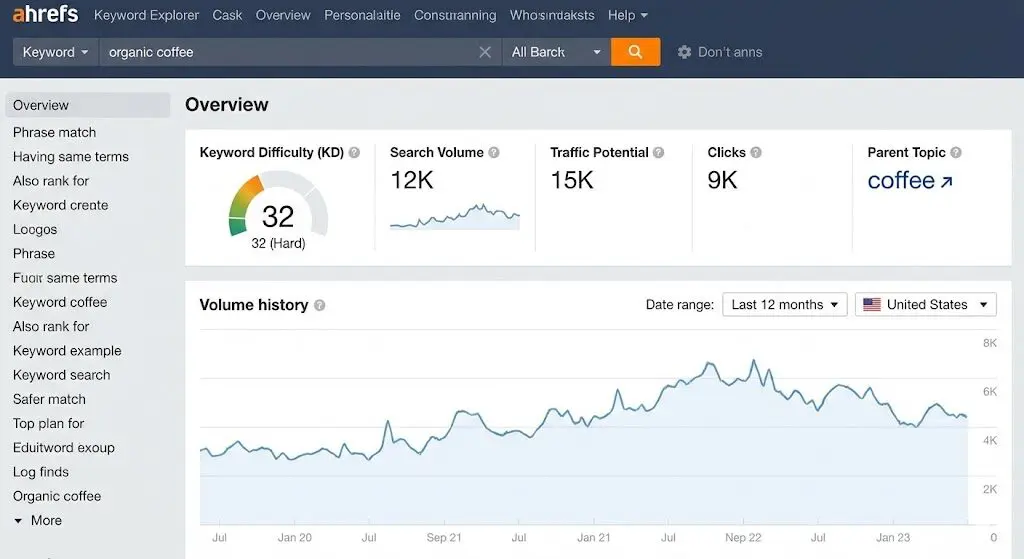
Core Metrics Explained
Search Volume
This is the average monthly searches based on clickstream data. It is best used as a relative metric rather than an absolute one. Comparing keywords within the same niche is more useful than comparing across industries.
Keyword Difficulty
Ahrefs Keyword Difficulty estimates how many referring domains the top ranking pages have on average. It does not measure content quality or intent match. Low KD does not always mean easy, and high KD does not always mean impossible.
Traffic Potential
Traffic Potential estimates the total organic traffic the top ranking page receives for all its ranking keywords. This metric is often more important than search volume because one page usually ranks for dozens or hundreds of related terms.
Clicks
Some keywords have high search volume but low clicks due to ads, featured snippets, or instant answers. Click data helps avoid keywords that look attractive but drive little traffic.
Parent Topic
The Parent Topic groups related keywords under one broader topic. It helps decide whether multiple keywords should be targeted with one page instead of several.
How to Use Ahrefs for SEO Keyword Research Step by Step
Step 1: Start with the Right Seed Keywords
Seed keywords should represent real problems, products, or questions, not vague ideas. A strong seed keyword is usually something customers or readers would naturally type into Google. Using multiple seed keywords is recommended to uncover different angles and subtopics.
Avoid starting with extremely broad terms, especially for newer or lower authority sites. These usually produce overwhelming results with high competition.
Step 2: Explore Keyword Ideas Reports
Ahrefs Keyword Explorer offers several reports, but not all are equally useful in every situation.
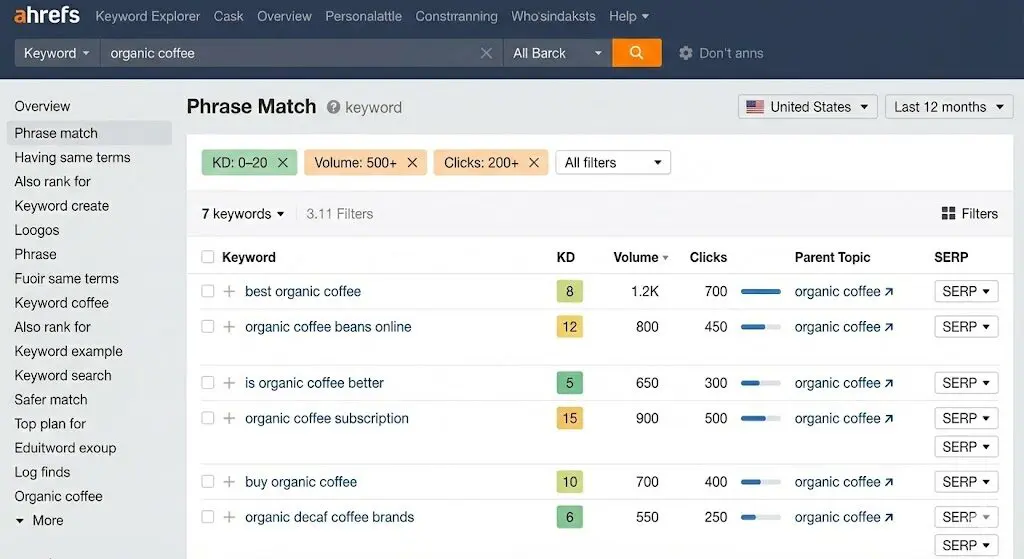
Phrase Match
This report is ideal for finding variations and long tail keywords that closely relate to the seed keyword. It works well for commercial and informational content alike.
Having Same Terms
This report helps uncover keywords that contain all the words in the seed keyword but in different structures. It is useful for expanding coverage within a topic cluster.
Questions
Question-based keywords are valuable for blog content, FAQs, and featured snippet opportunities. These keywords often have clear informational intent and lower competition.
How to Find Low Competition Keywords with Ahrefs
Finding low competition keywords requires more than sorting by Keyword Difficulty. Ahrefs provides enough data to assess true ranking difficulty when used correctly.
Use Smart Filters
A common starting point is setting Keyword Difficulty to a realistic range based on site authority. For many sites, a KD between 0 and 20 is a practical threshold. Search volume should be filtered to remove keywords with no traffic, but extremely high volume is not required.
Clicks should also be considered. Keywords with clicks close to zero often underperform even if rankings are achieved.
Analyze the SERP, Not Just the Metrics
Clicking into the SERP overview is essential. Look for signals of weak competition such as forums, Q&A sites, outdated content, or pages that do not fully match search intent. Pages with low referring domains and thin content often indicate opportunity.
If the top results are dominated by strong brands or highly authoritative domains with hundreds of backlinks, the keyword is likely not a good short-term target.
Balance Traffic Potential and Difficulty
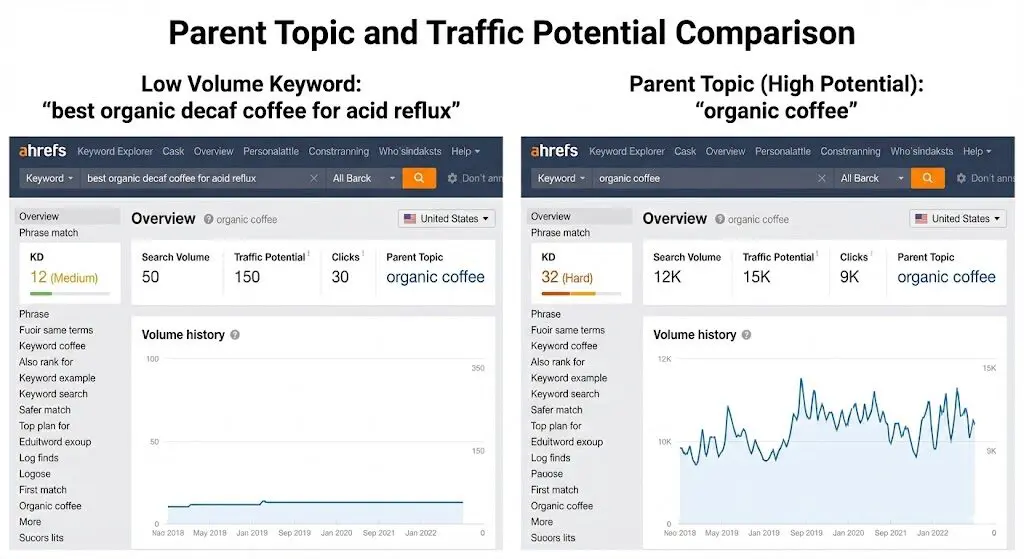
Low volume keywords can still deliver meaningful traffic if the Traffic Potential is high. This often happens when one page ranks for many closely related terms. Prioritizing Traffic Potential helps identify keywords that support scalable content.
Building a Keyword Research Strategy with Ahrefs
Keyword research should feed directly into a broader SEO strategy, not exist as a standalone task.
Group Keywords into Topic Clusters
Using the Parent Topic feature helps group related keywords efficiently. Keywords that share the same Parent Topic are often best targeted with a single comprehensive page. This approach supports topical authority and reduces keyword cannibalization.
In some cases, manual clustering is necessary when intent differs despite shared terminology. SERP analysis should guide this decision.
Match Keywords to Search Intent
Every keyword reflects intent. Informational keywords require educational content. Commercial keywords require comparison or evaluation. Transactional keywords require product or service pages.
Ahrefs SERP features make intent visible. The presence of ads, shopping results, or review pages indicates commercial intent. Featured snippets and question-based results indicate informational intent. Matching content type and format to intent is essential for ranking.
Advanced Ahrefs Keyword Research Workflows
Competitor Analysis with Content Gap
The Content Gap tool identifies keywords that competitors rank for but the target site does not. Filtering by relevance, intent, and Keyword Difficulty helps surface realistic opportunities.
This workflow is especially effective for established sites looking to expand topical coverage or catch up to competitors.
Scaling with the Top Pages Report
The Top Pages report shows which pages generate the most organic traffic for a competitor. Analyzing these pages reveals which topics drive results and which keywords support them. Extracting secondary keywords from these pages helps build more comprehensive content.
This approach often delivers faster results than creating entirely new topics.
Use Rank History to Avoid Volatile SERPs
Rank history shows how stable the top results are over time. Keywords with constant ranking changes may indicate unstable intent or algorithm sensitivity. Stable SERPs are usually safer targets for long-term content.
Common Mistakes in Keyword Research with Ahrefs
Relying on Keyword Difficulty alone
KD reflects backlinks, not intent or content quality. Always validate difficulty by reviewing the actual ranking pages and their referring domains.
Ignoring search intent signals in the SERP
Mixed SERPs usually fail. If guides, tools, and product pages rank together, the keyword is unstable or requires a hybrid approach.
Prioritizing search volume over Traffic Potential
Low volume keywords with high Traffic Potential often outperform higher volume terms because they rank for many related queries.
Targeting low competition keywords with no clicks
Some keywords look easy but generate little traffic due to ads or instant answers. Always check the Clicks metric.
Creating multiple pages for the same Parent Topic
When Ahrefs shows one Parent Topic, Google usually wants one authoritative page, not several competing ones.
Using Content Gap without strict relevance filtering
Not every competitor keyword is worth targeting. Filter by intent and business relevance before prioritizing.
Turning Ahrefs Data into SEO Results
Keyword research with Ahrefs is most effective when treated as a decision-making framework rather than a data collection exercise. The tool provides everything needed to evaluate competition, understand intent, and estimate potential impact. Success comes from choosing keywords that align with site authority, user needs, and business goals.
When used strategically, Ahrefs becomes more than an SEO keyword research tool. It becomes a system for building content that ranks, attracts traffic, and supports sustainable growth.
Want Keyword Research That Actually Drives Traffic?
Keyword research with Ahrefs only works when the data is turned into clear priorities and execution-ready pages. Buzzcube helps brands uncover low competition, high impact keywords and translate them into SEO strategies that scale traffic and revenue, not just rankings.
If you want keyword research, content planning, or full SEO execution done with precision and clarity, explore Buzzcube’s affordable SEO services and see how data-driven SEO should work.